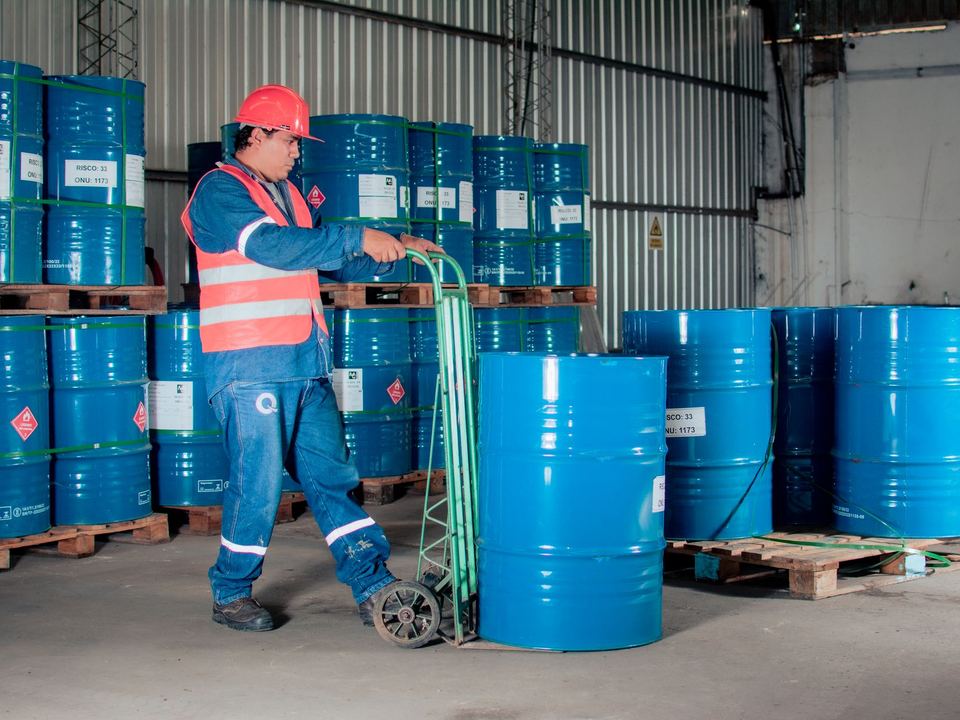
Industrial worker with a hand truck moving blue barrels in a warehouse setting.
RS-101 Flammables Store Racking & Spill Bunds Drum racking for 120 × 200 L · sump bunds ≥ 110 % · Ex lighting
Illustrative photo
Equipment list

Everything the plant needs

18 line items in process order, each with its tag, specification, quantity, power and an indicative unit price.

Equipment list (CSV)
RS-101
Raw materials

Flammables Store Racking & Spill Bunds

Drum racking for 120 × 200 L · sump bunds ≥ 110 % · Ex lighting

Holds resins, solvents, driers and pigments on bunded, earthed racks in a fire-rated store.

Qty
1
Power
0.5 kW
Unit price
$6,000–12,000
ST-102
Raw materials

Bulk Solvent Tank (White Spirit)

20,000 L · double-wall steel · flame arrester · level gauge

Stores white spirit in bulk so solvent is bought by tanker instead of by the drum.

Qty
1
Power
0.2 kW
Unit price
$9,000–16,000
PU-103
Solvent transfer

ATEX Air-Operated Solvent Pumps

1½" double diaphragm · Ex II 2G · conductive hoses · flow meter

Moves solvent and resin from tank and drums to the dispersers with no electric motor in the zone.

Qty
3
Power
—
Unit price
$1,200–2,500
HSD-201
Dispersion

Explosion-Proof High-Speed Disperser

22 kW Ex d motor · VFD · 300 mm Cowles blade · hydraulic lift · closed lid

Wets and disperses pigments and extenders into resin under a closed, nitrogen-blanketed lid.

Qty
2
Power
22 kW
Unit price
$9,000–16,000
DT-202
Dispersion

Mobile Dispersion Tubs

1,000 L · SS304 · castors · earthing lug · bottom valve

Move each batch between the disperser, bead mill and let-down tanks without re-pumping.

Qty
6
Power
—
Unit price
$1,500–3,000
NG-203
Inerting

PSA Nitrogen Generator

10 Nm³/h · 98 % N₂ · 500 L receiver · O₂ analyser

Blankets disperser and let-down vessels with nitrogen to keep oxygen below the ignition limit.

Qty
1
Power
0.5 kW
Unit price
$8,000–14,000
EB-204
Inerting

Static Earthing & Bonding System

12 monitored clamps · interlocked to pumps · earth pits < 10 Ω

Proves every drum, tub and tin is earthed before solvent can flow, preventing static sparks.

Qty
1
Power
0.1 kW
Unit price
$3,000–6,000
BM-301
Grinding

Horizontal Bead Mill (ATEX)

60 L chamber · 1.0–1.2 mm zirconia beads · 300–600 L/h · packaged chiller

Grinds the mill base to a Hegman 7 fineness for high-gloss enamels.

Qty
1
Power
37 kW
Unit price
$26,000–44,000
LD-302
Let-down

Let-Down Tank with Ex Stirrer

2,500 L · SS304 · Ex d agitator · load cells · N₂ inlet

Completes each batch with resin, solvent, driers and anti-skinning agent under slow stirring.

Qty
2
Power
7.5 kW
Unit price
$5,000–9,000
TM-401
Tinting

Tinting Dispenser & Spectrophotometer

16-canister dispenser · 0.077 ml resolution · d/8° spectro · colour software

Doses colourants and measures each batch against the master standard for repeatable colour.

Qty
1
Power
1.0 kW
Unit price
$9,000–16,000
QC-402
Quality

Paint QC Laboratory

Ford cup & KU viscometer · 60° glossmeter · Hegman gauge · closed-cup flash tester

Tests viscosity, gloss, grind, drying time, density and flash point before release.

Qty
1
Power
2.0 kW
Unit price
$8,000–15,000
FL-501
Filtering

Bag & Cartridge Filter Units

SS housing · 50 µm bag + 25 µm cartridge · ΔP gauge · earthed

Removes bead fragments, skins and grit so the paint flows clean into the tins.

Qty
2
Power
—
Unit price
$1,500–3,000
FM-502
Filling

Ex-Proof Semi-Auto Tin Filler

Pneumatic · Ex weigh-fill 0.5–20 L · anti-drip nozzle · ±1 % · 400 tins/h

Fills tins and pails by weight with pneumatic valves so no spark source sits at the nozzle.

Qty
2
Power
0.5 kW
Unit price
$6,000–11,000
LP-503
Packing

Lid Press, Labeller & Batch Coder

Pneumatic lid press · semi-auto wrap labeller · inkjet coder

Seals lids, applies GHS hazard labels and prints the batch code and expiry on every pack.

Qty
1
Power
1.5 kW
Unit price
$5,000–9,000
SR-601
Solvent recovery

Solvent Recovery Still

125 L batch · thermal-oil heated · Ex e · water-cooled condenser · ≈ 85 % yield

Distils dirty wash solvent back to clean solvent for the next wash-out.

Qty
1
Power
9 kW
Unit price
$12,000–22,000
VX-602
Safety

Vapour Extraction & LEV System

ATEX fans · 12,000 m³/h · capture hoods at lids & fillers · roof stack

Pulls solvent vapour away from openings so the air stays well below the lower explosive limit.

Qty
1
Power
11 kW
Unit price
$10,000–18,000
FS-603
Safety

Foam Fire Suppression System

AFFF-free foam proportioner · deluge heads · 50 m³ fire tank · gas detectors

Floods the stores and process hall with foam and alarms when solvent vapour is detected.

Qty
1
Power
5.5 kW
Unit price
$18,000–32,000
AC-604
Utilities

Screw Air Compressor & Dryer

3 m³/min at 7 bar · refrigerated dryer · 1,000 L receiver

Supplies air for diaphragm pumps, pneumatic fillers, lid press and the nitrogen generator.

Qty
1
Power
18.5 kW
Unit price
$7,000–12,000
Line items18
Machines29
Connected load≈ 147 kW
Equipment budgetUS$176,600 – 319,500

Indicative ex-works prices (US$, 2026) for budgeting a sample project, not quotations. Photos are illustrative of each machine class.

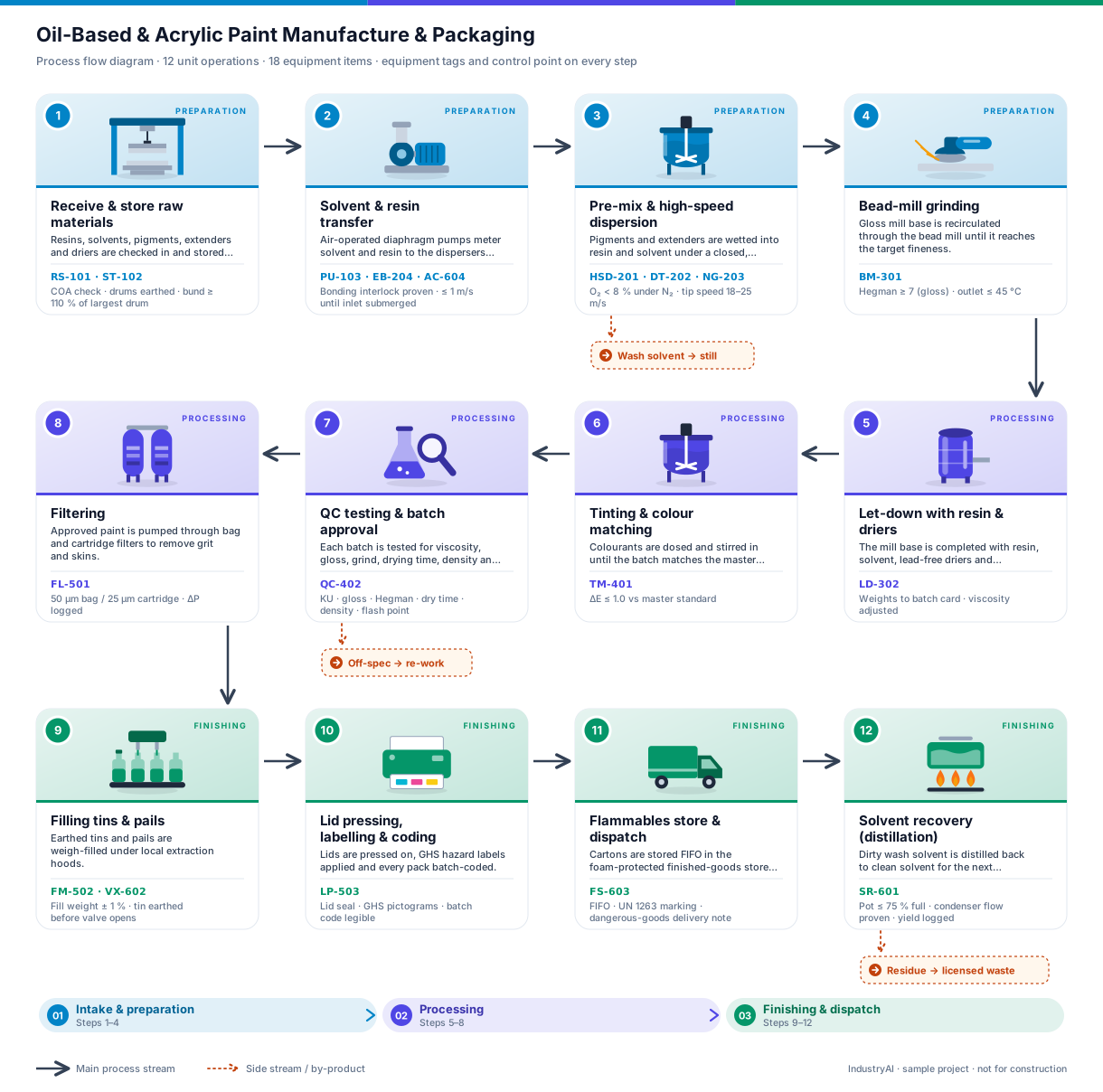
Process flow diagram

From raw material to dispatch

12 unit operations in order, with the equipment that performs each and its control point.

Download PFD (SVG)
Process flow diagram of the Oil-Based & Acrylic Paint Manufacture & Packaging: 1. Receive & store raw materials, 2. Solvent & resin transfer, 3. Pre-mix & high-speed dispersion, 4. Bead-mill grinding, 5. Let-down with resin & driers, 6. Tinting & colour matching, 7. QC testing & batch approval, 8. Filtering, 9. Filling tins & pails, 10. Lid pressing, labelling & coding, 11. Flammables store & dispatch, 12. Solvent recovery (distillation).
StepOperationEquipmentControl point
01 Receive & store raw materialsResins, solvents, pigments, extenders and driers are checked in and stored on bunded, earthed racks. RS-101 Flammables Store Racking & Spill BundsST-102 Bulk Solvent Tank (White Spirit) COA check · drums earthed · bund ≥ 110 % of largest drum
02 Solvent & resin transferAir-operated diaphragm pumps meter solvent and resin to the dispersers through conductive hoses. PU-103 ATEX Air-Operated Solvent PumpsEB-204 Static Earthing & Bonding SystemAC-604 Screw Air Compressor & Dryer Bonding interlock proven · ≤ 1 m/s until inlet submerged
03 Pre-mix & high-speed dispersionPigments and extenders are wetted into resin and solvent under a closed, nitrogen-blanketed lid.Wash solvent → still HSD-201 Explosion-Proof High-Speed DisperserDT-202 Mobile Dispersion TubsNG-203 PSA Nitrogen Generator O₂ < 8 % under N₂ · tip speed 18–25 m/s
04 Bead-mill grindingGloss mill base is recirculated through the bead mill until it reaches the target fineness. BM-301 Horizontal Bead Mill (ATEX) Hegman ≥ 7 (gloss) · outlet ≤ 45 °C
05 Let-down with resin & driersThe mill base is completed with resin, solvent, lead-free driers and anti-skinning agent. LD-302 Let-Down Tank with Ex Stirrer Weights to batch card · viscosity adjusted
06 Tinting & colour matchingColourants are dosed and stirred in until the batch matches the master colour standard. TM-401 Tinting Dispenser & Spectrophotometer ΔE ≤ 1.0 vs master standard
07 QC testing & batch approvalEach batch is tested for viscosity, gloss, grind, drying time, density and flash point.Off-spec → re-work QC-402 Paint QC Laboratory KU · gloss · Hegman · dry time · density · flash point
08 FilteringApproved paint is pumped through bag and cartridge filters to remove grit and skins. FL-501 Bag & Cartridge Filter Units 50 µm bag / 25 µm cartridge · ΔP logged
09 Filling tins & pailsEarthed tins and pails are weigh-filled under local extraction hoods. FM-502 Ex-Proof Semi-Auto Tin FillerVX-602 Vapour Extraction & LEV System Fill weight ± 1 % · tin earthed before valve opens
10 Lid pressing, labelling & codingLids are pressed on, GHS hazard labels applied and every pack batch-coded. LP-503 Lid Press, Labeller & Batch Coder Lid seal · GHS pictograms · batch code legible
11 Flammables store & dispatchCartons are stored FIFO in the foam-protected finished-goods store and shipped as Class 3 goods. FS-603 Foam Fire Suppression System FIFO · UN 1263 marking · dangerous-goods delivery note
12 Solvent recovery (distillation)Dirty wash solvent is distilled back to clean solvent for the next equipment wash-out.Residue → licensed waste SR-601 Solvent Recovery Still Pot ≤ 75 % full · condenser flow proven · yield logged
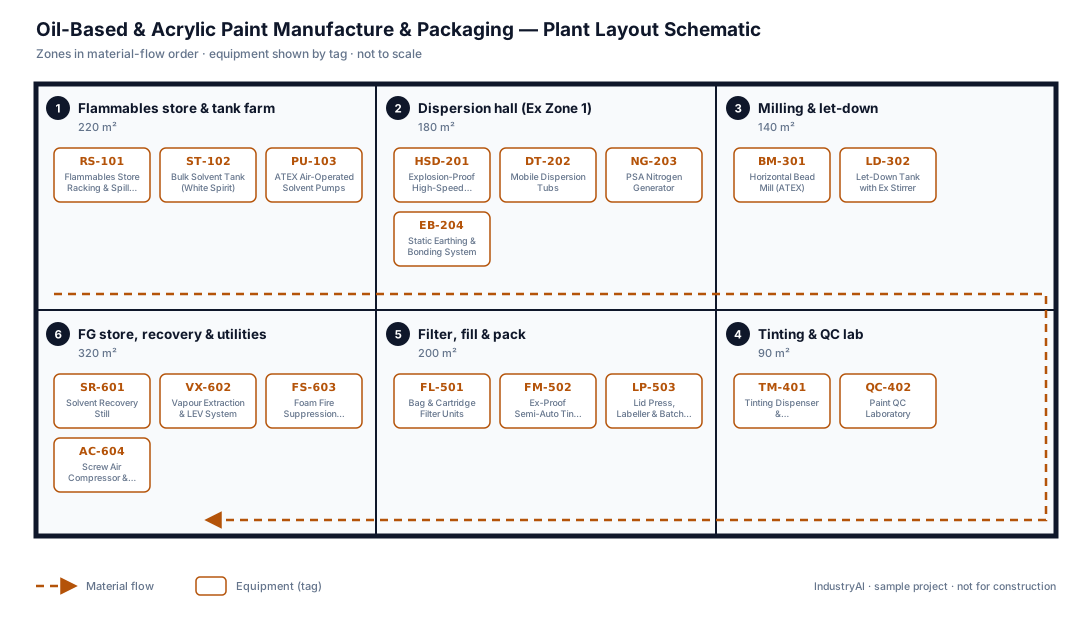
Schematic

Plant layout

6 zones arranged for one-way material flow, with every item of equipment placed by tag.

Download layout (SVG)
Plant layout schematic of the Oil-Based & Acrylic Paint Manufacture & Packaging: Flammables store & tank farm, Dispersion hall (Ex Zone 1), Milling & let-down, Tinting & QC lab, Filter, fill & pack, FG store, recovery & utilities.
Features & capacities

Why this line works

ATEX-rated throughout

Ex motors, air-driven pumps, nitrogen blanketing and interlocked earthing in every solvent zone.

Bead-mill fine grind

Hegman 7 grind gives the deep, even gloss that premium enamels are judged on.

In-house tinting

A spectrophotometer and dispenser hold every colour within ΔE 1.0 of its master.

Solvent recovery

The still returns about 85 % of wash solvent, cutting solvent purchases and hazardous waste.

Foam fire protection

Gas detection and a foam deluge system cover both flammables stores and the process hall.

Lead-free, batch-released

Lead-free driers and pigments (≤ 90 ppm lead) and a certificate of analysis for every batch.

Capacities

Dispersion
2 × 1,000 L · ≈ 6 batches/shift
Bead milling
300–600 L/h mill base (Hegman 7)
Let-down
2 × 2,500 L stirred tanks
Filling
Up to 400 tins/h per filler (4 L)
Solvent recovery
≈ 250 L/day wash solvent · 85 % recovered
Gloss formula cost
≈ KES 407/L white alkyd gloss (1,000 L batch)

Utilities required

Electricity
≈ 150 kW connected · 415 V 3-phase · Ex-rated in Zones 1/2
Compressed air
3 m³/min at 7 bar, dried
Nitrogen
10 Nm³/h at 98 % from on-site PSA
Cooling water
25 kW packaged chiller loop at 15 °C (bead mill, still)
Fire water
50 m³ dedicated tank + foam concentrate
Hazardous waste
Still residue & rags to NEMA-licensed handler
Process instructions

Standard operating procedures

The core routines operators follow, from start-up to batch release.

01Flammable-solvent safety

  1. Treat the dispersion hall, filling area and stores as ATEX Zone 1/2: only Ex-rated tools, lamps and phones.
  2. Clip the earthing clamp to every drum, tub and tin and wait for the green lamp before transferring solvent.
  3. No hot work, smoking or naked flames anywhere in the plant without a signed hot-work permit and gas test.
  4. Wear anti-static footwear, cotton overalls, nitrile gloves, goggles and an organic-vapour respirator when lids are open.
  5. Keep a spill kit and foam extinguisher at every station; contain spills with absorbent, never wash them to drain.

02Making a gloss enamel batch

  1. Weigh resin and solvent into an earthed tub, close the lid and purge with nitrogen until O₂ reads below 8 %.
  2. Add dispersant, then pigments and extenders slowly at low speed before raising tip speed to 18–25 m/s.
  3. Recirculate the mill base through the bead mill until Hegman reads 7, keeping outlet temperature below 45 °C.
  4. Let down with the remaining resin and solvent, then add driers and anti-skinning agent last.

03QC, filling & release

  1. Test viscosity, gloss, grind, drying time, density and flash point against the product specification.
  2. Tint to the master standard and re-test colour; send off-spec batches back for re-work, never to the filler.
  3. Filter every batch through 50 µm bags and 25 µm cartridges, changing elements when ΔP rises.
  4. Fill only into earthed tins, press lids, apply GHS labels and check the batch code on the first and last pack.

04Cleaning, recovery & waste

  1. Wash tubs and the bead mill with recovered solvent in a closed circuit, not with fresh solvent.
  2. Run the still only with condenser water proven and never fill the pot above 75 %.
  3. Drum still residue, dirty rags and filter bags in closed, labelled drums for the NEMA-licensed handler.
  4. Keep a retained sample of every batch for 24 months and log recovered solvent volumes weekly.
Process documents

The full project document

7 sections: open any one to read it, or download the whole document.

01Executive Summary

Rangi Bora Coatings Ltd is a solvent-borne paint plant in Ruiru, Kiambu County, making alkyd gloss enamels, solvent acrylic road-marking, floor and roof paints, red oxide and zinc phosphate primers, wood varnish and thinners. The plant runs a single shift on an ATEX-rated line of two high-speed dispersers, a horizontal bead mill, stirred let-down tanks and explosion-proof fillers, packing 5,500 litres a day into 0.5 L, 1 L and 4 L tins and 20 L pails. It sells through hardware distributors in Nairobi and central Kenya, direct to contractors, and on county and road-agency marking tenders.

MetricValue
Production Capacity5,500 L/day · ≈ 121,000 L/month (single shift)
Product Lines5 (gloss enamels, road/floor/roof paints, primers, varnish, thinners)
Annual Revenue (Year 1)KES 333,000,000 (~$2.56M) at 45% utilisation
Initial InvestmentKES 52,000,000 (~$400,000) + KES 25M working-capital facility
Average Ex-Works PriceKES 509/L against a full cost of KES 431/L
Break-even≈ 1,470 L/day (27% of capacity) · operating break-even Month 4
Payback Period≈ Month 17 (pre-tax)
Employees40
02Products & Formulations

Product Range

ProductBinder / SolventPacksShare of VolumeEx-Works Price (KES/L)
Alkyd gloss enamel (white)Long-oil soya alkyd / white spirit0.5 L, 1 L, 4 L18%660
Alkyd gloss enamel (colours)Long-oil soya alkyd / white spirit0.5 L, 1 L, 4 L27%590
Road-marking, floor & roof paintThermoplastic acrylic / xylene4 L, 20 L20%480
Red oxide & zinc phosphate primersMedium-oil alkyd / white spirit1 L, 4 L, 20 L15%380
Wood varnish (clear & tinted)Urethane-modified alkyd / white spirit0.5 L, 1 L, 4 L8%600
Thinners & cleaning solventWhite spirit, xylene blends1 L, 4 L, 20 L12%250

White Alkyd Gloss Enamel (per 1,000 L batch, density 1.20 kg/L)

Ingredient% w/wQuantityCost/kg (KES)Total (KES)
Long-oil alkyd resin (70% solids in white spirit)52.0%624 kg330205,920
Titanium dioxide, rutile22.0%264 kg480126,720
Micronised calcium carbonate5.0%60 kg251,500
White spirit18.0%216 kg17036,720
Lead-free driers (cobalt/zirconium/calcium)1.5%18 kg90016,200
Anti-skinning agent (MEKO)0.3%3.6 kg7002,520
Dispersant, anti-settling & flow additives1.2%14.4 kg1,20017,280
Total per 1,000 L100%1,200 kg406,860
Raw-material cost per litre≈ 407

Coloured gloss enamels replace most of the titanium dioxide with lower-loading organic and iron-oxide pigments, bringing raw-material cost down to about KES 355/L. Primers use red iron oxide or zinc phosphate with more extender in a medium-oil alkyd, at about KES 230/L.

Solvent Acrylic Paints

Road-marking, floor and roof paints are built on a thermoplastic acrylic resin dissolved in xylene with chlorinated-paraffin plasticiser. They dry by solvent evaporation, not oxidation, so they need no driers and reach no-pick-up in under 15 minutes on the road. Road-marking whites use rutile TiO₂ and calcite; yellows use lead-free organic pigments (lead chromate is not used). Glass beads are supplied separately for drop-on retro-reflectivity. Because xylene has a lower flash point than white spirit, these batches are made and filled only with the nitrogen blanket and extraction running.

Key Suppliers

  • Resins: Local alkyd and acrylic resin makers in Nairobi and Mombasa, with imported back-up from India and the Gulf
  • Pigments & TiO₂: Chemical importers in Nairobi's Industrial Area, landed from China, India and South Africa
  • Solvents: White spirit and xylene by tanker from oil marketers, stored in the 20,000 L bulk tank
  • Packaging: Printed tinplate tins and plastic pails from Nairobi and Thika can makers
03Production Process

Main Line (5,500 L/day)

StageProcessPurposeEquipment
1Receiving & StorageCheck COAs, store on bunded, earthed racksFlammables store, 20,000 L solvent tank
2Solvent TransferMeter solvent and resin with no spark source3 ATEX diaphragm pumps, interlocked earthing
3Pre-mix & DispersionWet pigments into resin under nitrogen2 × 22 kW Ex dispersers, 1,000 L tubs, PSA nitrogen
4Bead MillingGrind gloss mill base to Hegman 760 L horizontal bead mill with packaged chiller
5Let-downAdd remaining resin, solvent, driers, anti-skin2 × 2,500 L stirred tanks on load cells
6Tinting & Colour MatchingMatch to master standardColourant dispenser, spectrophotometer
7QC TestingApprove batch against specificationViscometers, glossmeter, Hegman gauge, flash tester
8FilteringRemove grit, skins and bead fragments50 µm bag + 25 µm cartridge filters
9FillingWeigh-fill tins and pails2 pneumatic Ex semi-auto fillers under LEV hoods
10Lid Pressing, Labelling & CodingSeal, apply GHS labels, batch codeLid press, wrap labeller, inkjet coder
11Storage & DispatchFIFO storage and Class 3 shipmentFoam-protected finished-goods store

Batch Cycle

  • Gloss enamel: 45 min dispersion, 2–3 h bead milling, 1 h let-down, 1 h tinting and QC, then filling
  • Primers and road paints: Disperser only to Hegman 3–5, so a 1,000 L batch is ready to fill in about 3 hours
  • Thinners: Blended by weight in a let-down tank and filled the same day

Safety Systems

  • Inerting: PSA nitrogen blankets disperser and let-down vessels, keeping oxygen below 8%
  • Earthing & bonding: Monitored clamps interlocked to the pumps and fillers; no earth, no flow
  • Ventilation: 12,000 m³/h ATEX extraction with capture hoods at every open lid and filling nozzle
  • Fire: Solvent-vapour detectors, foam deluge over both stores and the hall, 50 m³ fire-water tank

Side Streams

  • Wash solvent: About 250 L/day is distilled in the recovery still; 85% returns to wash-out duty
  • Still residue: Pigment and resin sludge (≈ 40 L/day) is drummed for a NEMA-licensed hazardous-waste handler
  • Off-spec batches: Corrected by re-tinting or re-working into darker shades and primers, never discarded
  • Filter bags & rags: Stored in closed metal bins and collected with the still residue
04Quality Standards & Compliance

Regulatory Requirements

Licence / ObligationAuthority / LawTimelineCost (KES)
KEBS Standardization Mark per product (KS paint, primer, varnish and road-marking standards)KEBS2–3 months0.2% of ex-factory sales (minimum fee applies)
Lead in paint ≤ 90 ppm (total lead, all products)KEBS paint standardsBefore first sale~15,000 per product test
EIA Licence (project report)NEMA, EMCA 19992–3 months0.1% of project cost + ~250,000 expert fees
Air emission (VOC) licenceNEMA, Air Quality Regulations 20141–2 months~50,000/year
Hazardous waste handling (still residue, rags)NEMA, Waste Management Regulations 2006Ongoing~35,000/t collected
Workplace registration, flammables storage & fire auditDOSHS, OSHA 2007 & Fire Risk Reduction Rules 20071 month, then annual~80,000/year
GHS hazard labels & safety data sheetsOSHA 2007, Hazardous Substances Rules 2007Before first saleDesign cost only
Fire safety certificateKiambu County Fire Department2 weeks, then annual~25,000/year
Single Business PermitKiambu County2 weeks~60,000/year

Batch Test Parameters

ParameterMethodAlkyd Gloss EnamelRoad-Marking PaintPrimerFrequency
ViscosityStormer KU (ASTM D562), Ford cup No. 490–100 KU80–95 KU75–90 KUEvery batch
Fineness of grindHegman gauge (ISO 1524)≥ 7 Hegman≥ 3 Hegman≥ 5 HegmanEvery batch
Specular gloss 60°Glossmeter (ISO 2813)≥ 85 GUMattMattEvery batch
Drying time (touch / hard)ASTM D1640≤ 4 h / ≤ 16 hNo-pick-up ≤ 15 min≤ 2 h / ≤ 8 hEvery batch
DensityPyknometer (ISO 2811)1.15–1.25 kg/L1.45–1.60 kg/L1.35–1.50 kg/LEvery batch
Flash point (closed cup)ISO 3679≥ 38 °C≥ 23 °C≥ 38 °CEvery batch
ColourSpectrophotometer ΔE≤ 1.0≤ 1.5≤ 1.5Every batch
Total leadExternal accredited lab≤ 90 ppm≤ 90 ppm≤ 90 ppmQuarterly per product

Labelling: Every pack carries GHS flammable-liquid pictograms and hazard statements (Category 3 for white-spirit products, Category 2 or 3 for xylene products), UN 1263 shipping marks on outer cartons, the batch code, date of manufacture and a 24-month shelf life.

05Financial Projections

Capital Expenditure

ItemCost (KES)~US$
Dispersers, tubs, bead mill (with chiller), let-down tanks & tinting13,000,000100,000
Filters, Ex fillers, lid press, labeller & coder3,900,00030,000
QC laboratory1,500,00011,500
Flammables store racking, bulk solvent tank & ATEX pumps3,520,00027,100
Safety & environment (N₂, earthing, still, extraction, foam system)9,300,00071,500
Screw air compressor & dryer1,240,0009,500
Freight, clearance & installation4,560,00035,100
Civil works (fire-rated store, bunded floors, interceptor)6,200,00047,700
Ex-rated electrical installation & 200 kVA supply3,400,00026,200
Electric pallet trucks & delivery truck2,300,00017,700
Licences, EIA, KEBS certification & commissioning1,280,0009,800
Opening stock & start-up costs1,800,00013,800
Total52,000,000~400,000

Raw materials and distributor credit are funded by a separate KES 25M revolving working-capital facility secured on stock and receivables.

Cost per Litre at 80% Utilisation (KES/L)

ProductRaw MaterialsPackagingConversionSelling & DistributionFull CostEx-Works PriceMargin
White alkyd gloss (4 L)40732434052266021%
Coloured alkyd gloss (4 L)35532434047059020%
Road-marking paint (20 L)32018434042148012%
Red oxide primer (4 L / 20 L)23026434033938011%
Wood varnish (1 L)38045434050860015%
Thinners (mixed packs)1653515252402504%
Plant average31830434043150915%

Monthly Operating Costs at Full Capacity (121,000 L)

ItemMonthly (KES)
Raw materials (KES 318/L)38,478,000
Tins, pails, labels & cartons (KES 30/L)3,630,000
Electricity (~20,000 kWh)500,000
Distribution & dangerous-goods transport1,800,000
Sales, distributor rebates & tinting-point support3,000,000
Staff salaries (40 employees)2,150,000
Rent & rates450,000
Maintenance, beads & filter elements300,000
Hazardous-waste disposal, licences & fire insurance500,000
Admin & office400,000
Total Monthly OPEX51,208,000 (~$394,000)

At full capacity monthly revenue is about KES 61.6M (~$474,000), leaving roughly KES 10.4M EBITDA. Fixed costs are KES 3.8M/month against a contribution of about KES 117/L, so break-even is about 32,400 L/month (≈ 1,470 L/day, 27% of capacity).

Three-Year Outlook

YearUtilisationVolume (L)Revenue (KES)EBITDA (KES)EBITDA Margin
Year 145%653,400333,000,000 (~$2.56M)31,000,0009%
Year 265%943,800480,500,000 (~$3.70M)62,700,00013%
Year 380%1,161,600591,400,000 (~$4.55M)85,900,00015%

Payback: cumulative EBITDA covers the KES 52M investment around Month 17 (pre-tax, before working-capital interest).

06Market Analysis & Opportunity

Kenya's paint and coatings market is estimated at KES 30–35 billion a year, growing 6–8% with housing, roads and commercial construction. Solvent-borne products still hold roughly a third of the value: alkyd gloss is the default finish for doors, windows, grilles and metalwork, and road agencies and county governments buy solvent acrylic road-marking paint every year. Mid-tier brands are squeezed between premium multinationals and unbranded products that often fail on lead, gloss and drying time, leaving room for a certified, lead-free, mid-priced range.

Market Sizing (TAM / SAM / SOM)

TierDefinitionValue (KES)
TAMEast African solvent-borne decorative, road-marking and protective coatings25 billion
SAMNairobi, central Kenya and Rift Valley distributors, contractors and road tenders9 billion
SOM (Year 3)Rangi Bora share at ~6.5% of SAM (≈ 1.16 million L/year)591 million

Customer Segments

SegmentProductsChannelShare of Revenue
Hardware stores & paint centresGloss enamels, primers, varnish, thinnersDistributors, 45-day credit, in-store tinting50%
Building & fit-out contractorsGloss, primers, floor paint in 20 LDirect sales, project pricing20%
Road agencies, counties & line contractorsRoad-marking paint, thinnersTenders and sub-contracts18%
Metal fabricators & furniture makersPrimers, gloss, varnishDirect and trade counter8%
Institutions & estatesRoof and floor paints, glossMaintenance contracts4%

Competitive Landscape

PlayerPositioningWeakness
Crown Paints, Basco, Kansai Plascon (Sadolin)Premium brands, national tinting networksHigh shelf prices, little flexibility on contractor terms
Mid-size local makersPrice-led gloss and primer rangesInconsistent gloss and colour, patchy KEBS certification
Unbranded and informal paintLowest price in hardware storesLead-containing driers and pigments, poor coverage, no SDS
Imported road-marking paintSpecified on large highway contractsLong lead times, currency exposure

Rangi Bora differentiation: bead-milled, lead-free gloss with a certificate of analysis for every batch, spectrophotometer colour matching within ΔE 1.0, locally made road-marking paint delivered in days, and 20 L contractor packs priced 15–20% below premium brands.

07Implementation Timeline & Risks

Implementation Timeline

MonthMilestoneOwnerDependency
M1Lease industrial site, submit EIA project report, fire engineer's layoutMDSite with separation distance for the flammables store
M2Equipment order (30% deposit), 200 kVA power applicationMDFinancing closed
M2–M4Civil works: fire-rated stores, bunded floors, interceptor, tank plinthPlant ManagerEIA licence issued
M3–M4Formulation trials with resin suppliers, colour card and master standardsTechnical ManagerLab equipment on site
M5Equipment arrives; Ex electrical installation and earthing testsPlant ManagerPower supply energised
M6Commissioning, fire system acceptance, DOSHS and county fire inspectionsPlant ManagerFoam system tested
M6–M7KEBS product testing and S-Mark, lead test certificatesQA LeadTrial batches approved
M7Commercial launch through 30 distributors at 35% utilisationSales LeadKEBS marks issued
M12Single shift at 55–60% utilisation, first road-marking tenderMDTender pre-qualification

Key Risks & Mitigation

RiskImpactMitigation
Fire or vapour explosionHighATEX zoning, nitrogen blanketing, interlocked earthing, gas detection, foam system, hot-work permits
TiO₂, resin and solvent price swingsHighQuarterly supplier contracts, 45 days of stock, price reviews with distributors every quarter
Currency depreciation on imported pigmentsMediumLocal resin sourcing, USD-linked price clauses on large contracts
Distributor credit and bad debtMediumCredit limits, 45-day terms, credit insurance on large accounts
Price competition from premium and informal brandsMediumCertified lead-free quality, contractor packs, tinting points in partner stores
Delayed tender payments from road agenciesMediumCap tender work at 20% of revenue, invoice discounting
Hazardous-waste or VOC non-complianceMediumSolvent recovery, licensed waste handler, extraction monitoring, NEMA returns

Get the complete package

Equipment specifications, process flow diagrams, recipes and the business plan, bundled as one download.