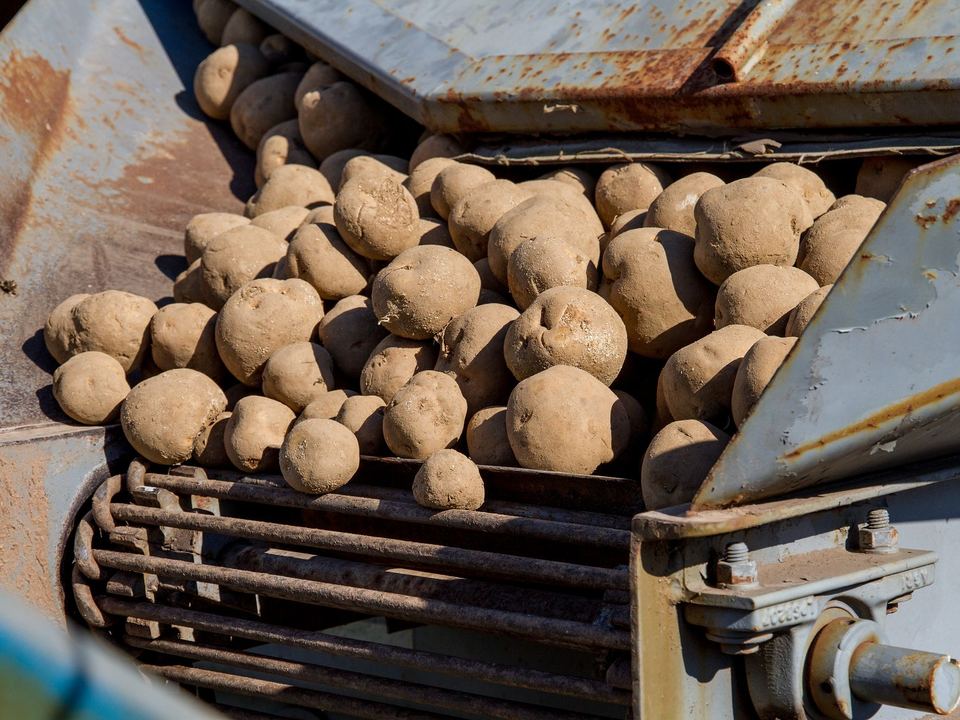
Close-up of freshly harvested potatoes on a rusty conveyor machine outdoors, showcasing agricultural…
WD-201 Drum Washer & Destoner 1.5 t/h · stone trap flume · SS304 · recirculated water
Illustrative photo
Equipment list

Everything the plant needs

18 line items in process order, each with its tag, specification, quantity, power and an indicative unit price.

Equipment list (CSV)
ST-101
Receiving

Ventilated Potato Store & Intake Hopper

500 t bulk · 8–10 °C · 85–95 % RH · 3 t intake hopper

Holds contract potatoes at a sugar-safe 8–10 °C and meters them to the line through a hopper.

Qty
1
Power
15 kW
Unit price
$30,000–55,000
WD-201
Washing

Drum Washer & Destoner

1.5 t/h · stone trap flume · SS304 · recirculated water

Tumbles potatoes under spray bars and drops out stones before they can damage the peeler.

Qty
1
Power
7.5 kW
Unit price
$8,000–15,000
PL-202
Peeling

Continuous Brush-Roller Peeler

1.5 t/h · 9 abrasive/brush rollers · adjustable dwell

Abrades the skin off continuously with water sprays, keeping peel loss to about 12–15 %.

Qty
1
Power
7.5 kW
Unit price
$12,000–22,000
IN-203
Inspection

Roller Inspection & Trim Conveyor

6 m · 6 trim stations · LED lighting · reject chutes

Rotates tubers under good light so operators trim green, rot and eye defects.

Qty
1
Power
1.5 kW
Unit price
$4,000–8,000
CT-301
Cutting

Fries Strip Cutter & Sliver Grader

700 kg/h · 7–14 mm grids · shaker removes slivers

Cuts peeled tubers into uniform strips and screens out slivers and nubbins.

Qty
1
Power
7.5 kW
Unit price
$15,000–30,000
SL-302
Cutting

Crisp Slicer & Starch-Wash Unit

600 kg/h · 1.2–1.8 mm flat or crinkle · counter-flow washer · starch cyclone

Slices potatoes to a tight tolerance, then rinses off free starch so slices fry evenly without sticking.

Qty
1
Power
9.5 kW
Unit price
$26,000–56,000
BL-401
Blanching

Rotary Hot-Water Blancher

700 kg/h · 70–85 °C · 8–15 min · thermal-oil heat exchanger

Leaches sugars and gelatinises the surface of fry strips for even colour and texture.

Qty
1
Power
5.5 kW
Unit price
$20,000–38,000
DW-403
Dewatering

Vibratory Dewaterer & Air Knife

700 kg/h · vibrating mesh · 3 air-knife blowers

Shakes and blows surface water off strips and slices before they enter the fryer.

Qty
2
Power
11 kW
Unit price
$7,000–14,000
FR-501
Frying

Continuous Fries Par-Fryer

400 kg/h out · 170–180 °C · 45–60 s · submerger belt · oil filter

Par-fries strips to set the crust while leaving the core moist for final frying.

Qty
1
Power
11 kW
Unit price
$60,000–110,000
FR-502
Frying

Continuous Crisps Fryer

120 kg/h crisps · 180 → 165 °C · paddles + submerger · fines removal

Fries slices to about 2 % moisture with continuous oil filtration and top-up.

Qty
1
Power
11 kW
Unit price
$55,000–100,000
TH-503
Utilities

Biomass Thermal-Oil Heater

800 kW (690,000 kcal/h) · 300 °C oil · briquette stoker

Heats the fryers and blancher indirectly, avoiding hot spots that degrade frying oil.

Qty
1
Power
22 kW
Unit price
$40,000–75,000
SE-601
Seasoning

De-Oiling Shaker & Seasoning Drum

150 kg/h · vibratory de-oiler · tumble drum · auger dosing

Drains surface oil and coats warm crisps evenly with dry seasoning.

Qty
1
Power
3 kW
Unit price
$10,000–20,000
IQF-701
Freezing

Fluidised-Bed IQF Tunnel Freezer

400–500 kg/h · −35 °C air · 12–15 min · pre-cooling zone

Freezes each fry individually to a −18 °C core so bags pour free.

Qty
1
Power
45 kW
Unit price
$140,000–240,000
RF-702
Utilities

Two-Stage Ammonia Refrigeration Plant

150 kW at −42 °C SST · screw compressors · evaporative condenser

Supplies the IQF tunnel with low-temperature refrigeration from a low-charge ammonia pack.

Qty
1
Power
130 kW
Unit price
$150,000–280,000
PK-801
Packing

Fries Weigher & VFFS Bagger

10-head weigher · 25–35 bags/min · metal detector + checkweigher

Weighs and bags frozen fries into retail and catering packs in a chilled packing room.

Qty
1
Power
6 kW
Unit price
$40,000–70,000
PK-802
Packing

Crisps Weigher & N₂ VFFS Line

14-head weigher · 60–70 bags/min · PSA N₂ generator · metal detector

Packs crisps in nitrogen-flushed metallised bags to keep them crunchy for 6 months.

Qty
1
Power
18 kW
Unit price
$50,000–90,000
CS-901
Storage

Prefab −18 °C Cold Store

300 t · 150 mm PU panels · 2 condensing units · racking + dock seal

Holds 6–8 weeks of frozen fries at −18 °C with continuous temperature logging.

Qty
1
Power
28 kW
Unit price
$90,000–160,000
QC-902
Quality

Quality-Control Lab Kit

Under-water weigher · colorimeter · polar-compound oil tester · moisture analyser

Checks dry matter, sugars, fry colour, oil quality and moisture for every batch.

Qty
1
Power
3 kW
Unit price
$8,000–16,000
Line items18
Machines19
Connected load≈ 353 kW
Equipment budgetUS$772,000 – 1,413,000

Indicative ex-works prices (US$, 2026) for budgeting a sample project, not quotations. Photos are illustrative of each machine class.

Process flow diagram

From raw material to dispatch

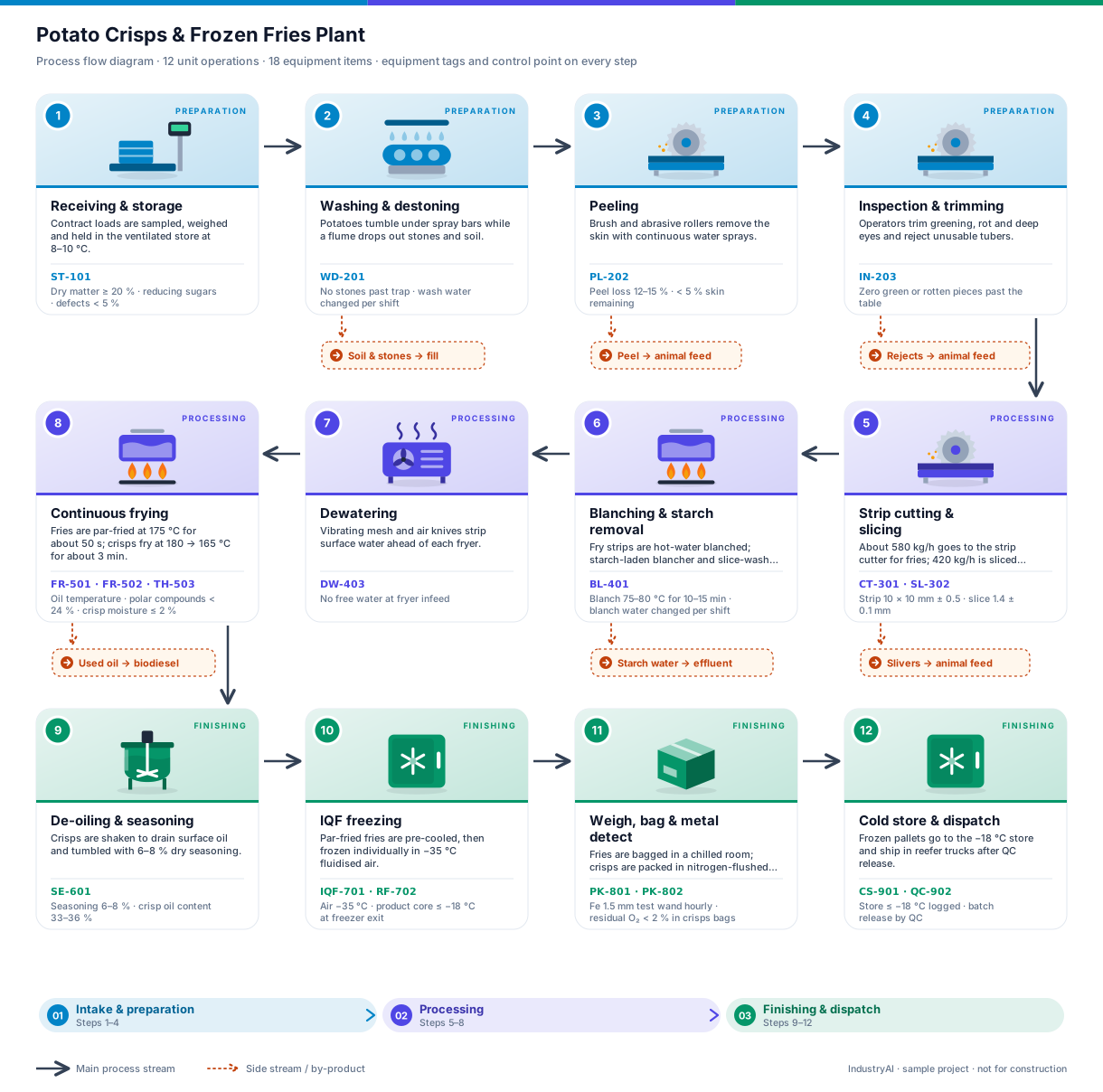
12 unit operations in order, with the equipment that performs each and its control point.

Download PFD (SVG)
Process flow diagram of the Potato Crisps & Frozen Fries Plant: 1. Receiving & storage, 2. Washing & destoning, 3. Peeling, 4. Inspection & trimming, 5. Strip cutting & slicing, 6. Blanching & starch removal, 7. Dewatering, 8. Continuous frying, 9. De-oiling & seasoning, 10. IQF freezing, 11. Weigh, bag & metal detect, 12. Cold store & dispatch.
StepOperationEquipmentControl point
01 Receiving & storageContract loads are sampled, weighed and held in the ventilated store at 8–10 °C. ST-101 Ventilated Potato Store & Intake Hopper Dry matter ≥ 20 % · reducing sugars · defects < 5 %
02 Washing & destoningPotatoes tumble under spray bars while a flume drops out stones and soil.Soil & stones → fill WD-201 Drum Washer & Destoner No stones past trap · wash water changed per shift
03 PeelingBrush and abrasive rollers remove the skin with continuous water sprays.Peel → animal feed PL-202 Continuous Brush-Roller Peeler Peel loss 12–15 % · < 5 % skin remaining
04 Inspection & trimmingOperators trim greening, rot and deep eyes and reject unusable tubers.Rejects → animal feed IN-203 Roller Inspection & Trim Conveyor Zero green or rotten pieces past the table
05 Strip cutting & slicingAbout 580 kg/h goes to the strip cutter for fries; 420 kg/h is sliced and washed for crisps.Slivers → animal feed CT-301 Fries Strip Cutter & Sliver GraderSL-302 Crisp Slicer & Starch-Wash Unit Strip 10 × 10 mm ± 0.5 · slice 1.4 ± 0.1 mm
06 Blanching & starch removalFry strips are hot-water blanched; starch-laden blancher and slice-wash water goes to effluent.Starch water → effluent BL-401 Rotary Hot-Water Blancher Blanch 75–80 °C for 10–15 min · blanch water changed per shift
07 DewateringVibrating mesh and air knives strip surface water ahead of each fryer. DW-403 Vibratory Dewaterer & Air Knife No free water at fryer infeed
08 Continuous fryingFries are par-fried at 175 °C for about 50 s; crisps fry at 180 → 165 °C for about 3 min.Used oil → biodiesel FR-501 Continuous Fries Par-FryerFR-502 Continuous Crisps FryerTH-503 Biomass Thermal-Oil Heater Oil temperature · polar compounds < 24 % · crisp moisture ≤ 2 %
09 De-oiling & seasoningCrisps are shaken to drain surface oil and tumbled with 6–8 % dry seasoning. SE-601 De-Oiling Shaker & Seasoning Drum Seasoning 6–8 % · crisp oil content 33–36 %
10 IQF freezingPar-fried fries are pre-cooled, then frozen individually in −35 °C fluidised air. IQF-701 Fluidised-Bed IQF Tunnel FreezerRF-702 Two-Stage Ammonia Refrigeration Plant Air −35 °C · product core ≤ −18 °C at freezer exit
11 Weigh, bag & metal detectFries are bagged in a chilled room; crisps are packed in nitrogen-flushed bags. PK-801 Fries Weigher & VFFS BaggerPK-802 Crisps Weigher & N₂ VFFS Line Fe 1.5 mm test wand hourly · residual O₂ < 2 % in crisps bags
12 Cold store & dispatchFrozen pallets go to the −18 °C store and ship in reefer trucks after QC release. CS-901 Prefab −18 °C Cold StoreQC-902 Quality-Control Lab Kit Store ≤ −18 °C logged · batch release by QC
Schematic

Plant layout

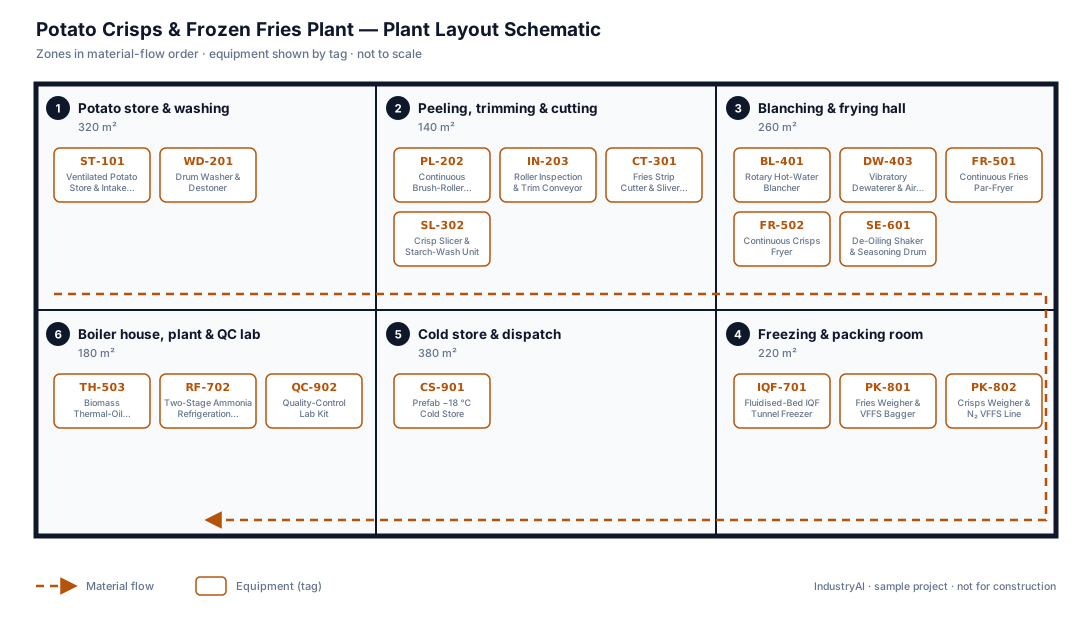
6 zones arranged for one-way material flow, with every item of equipment placed by tag.

Download layout (SVG)
Plant layout schematic of the Potato Crisps & Frozen Fries Plant: Potato store & washing, Peeling, trimming & cutting, Blanching & frying hall, Freezing & packing room, Cold store & dispatch, Boiler house, plant & QC lab.
Features & capacities

Why this line works

Two products, one intake

A shared wash-peel-trim front end feeds both lines, so large tubers go to fries and round ones to crisps.

Thermal-oil frying

Indirect heating keeps fryer walls cool, extending oil life and cutting burnt-oil off-flavours.

True IQF fries

Fluidised-bed freezing at −35 °C gives free-flowing fries that quick-service kitchens can portion.

Sugar-safe storage

Holding potatoes at 8–10 °C avoids cold sweetening, keeping fry colour light and acrylamide low.

Side streams earn money

Peel, trim and slivers go to pig and dairy farmers; used frying oil is sold for biodiesel.

Export-ready food safety

Metal detection on every bag, batch coding and HACCP records support KEBS and FSSC 22000.

Capacities

Raw potato intake
1.2 t/h · ≈ 19 t/day (2 shifts)
Frozen par-fried fries
400 kg/h · 6.4 t/day
Seasoned potato crisps
120 kg/h · 1.9 t/day
IQF freezing
Up to 500 kg/h at −35 °C air
Thermal-oil heater
800 kW (690,000 kcal/h)
Frozen storage
300 t at −18 °C (≈ 6–8 weeks)
Crisps packing
60–70 bags/min (30–150 g)

Utilities required

Electricity
≈ 420 kW connected · 630 kVA transformer · 500 kVA standby genset
Thermal fuel
≈ 2–2.5 t/day biomass briquettes for the thermal-oil heater
Water
≈ 70 m³/day potable; flume and wash water recirculated
Refrigeration
150 kW at −42 °C for IQF · 35 kW at −28 °C for cold store
Effluent
≈ 50 m³/day starch water: screen, settle, then anaerobic pond
Process instructions

Standard operating procedures

The core routines operators follow, from start-up to batch release.

01Daily start-up

  1. Fire the thermal-oil heater and bring circulating oil to 280–300 °C before heating the fryers.
  2. Start the refrigeration plant and pull the IQF tunnel down to −35 °C before any product enters.
  3. Check fryer oil level and total polar compounds; top up with fresh oil or change it if above 24 %.
  4. Set strip cutter grids and slicer gap for the scheduled SKU and check the first cuts with a gauge.
  5. Test both metal detectors with Fe, non-Fe and stainless test wands and record the results.

02Production run

  1. Feed the line from store lots that passed dry-matter and fry-colour tests; route larger tubers to fries.
  2. Record fryer oil temperature, belt speed and product colour every 30 minutes.
  3. Check fries core temperature at the IQF exit and crisp moisture and seasoning level every hour.
  4. Code each bag and carton with batch, line and date, and quarantine pallets until QC releases them.

03Cleaning & oil management

  1. Empty fines from the fryer filters every shift and skim the crisps fryer continuously.
  2. At the end of each day, wash down the intake, cutters and blancher and clean the slice washer screens.
  3. Weekly: boil out the fryers with alkaline cleaner, rinse to neutral pH and refill with filtered oil.
  4. Defrost the IQF coils each day and sanitise the belt and packing-room surfaces before start-up.
  5. Store used oil in sealed drums for the licensed biodiesel collector and log each volume.

04Quality checks

  1. Every incoming load: dry matter by under-water weight, reducing sugars and a fry-colour test.
  2. Every batch: fry colour against the USDA chart, crisp moisture, oil content and residual O₂ in bags.
  3. Monthly: send fries and crisps samples to an accredited lab for acrylamide against EU benchmarks.
  4. Keep retention samples of every batch for the full shelf life plus one month.
Process documents

The full project document

7 sections: open any one to read it, or download the whole document.

01Executive Summary

Highland Spud Foods Ltd is a potato-processing plant located in Njoro, Nakuru County, at the heart of Kenya's Nakuru–Nyandarua potato belt. It processes about 1.2 tonnes of contract-grown potatoes per hour into par-fried, individually quick frozen (IQF) French fries for supermarkets, quick-service restaurants (QSRs) and regional export, and into seasoned potato crisps for supermarket and convenience retail. The plant runs two shifts on a shared wash-peel-trim intake, with continuous thermal-oil-heated fryers, a −35 °C IQF tunnel and a 300-tonne cold store.

MetricValue
Frozen Fries Capacity400 kg/hour (6.4 t/day)
Potato Crisps Capacity120 kg/hour (1.9 t/day)
Raw Potato Intake1.2 t/hour (≈ 4,300 t/year at 80% utilisation)
Annual Revenue (Year 1)KES 365,000,000 (~$2.8M)
Initial InvestmentKES 240,000,000 (~$1.85M)
Operating Break-evenMonth 8
Payback Period~3.5 years
Employees68
Contract Farmers≈ 500 (about 250 ha)
02Production Process

Process Stages

StageProcessPurposeEquipment
1Receiving & StorageHold potatoes at 8–10 °C to avoid sugar build-up500 t ventilated store + intake hopper
2Washing & DestoningRemove soil and stonesDrum washer with stone trap (1.5 t/h)
3PeelingRemove skin with minimum loss9-roller brush/abrasive peeler
4Inspection & TrimmingRemove green, rot and eye defectsRoller inspection conveyor (6 stations)
5CuttingFry strips and crisp slicesStrip cutter (10 × 10 mm) + centrifugal slicer (1.4 mm)
6Blanching / WashingLeach sugars; remove surface starchRotary blancher (75–80 °C) + slice washer
7DewateringStrip surface waterVibratory dewaterers + air knives
8FryingPar-fry fries; fry crisps to 2% moistureTwo continuous fryers on an 800 kW thermal-oil heater
9De-oiling & SeasoningDrain oil, apply flavour (crisps)Vibratory de-oiler + tumble drum
10IQF FreezingFreeze fries to −18 °C coreFluidised-bed tunnel at −35 °C + ammonia plant
11PackingWeigh, bag, metal-detectTwo multihead weigher + VFFS lines (N₂ flush for crisps)
12Cold Store & DispatchHold and ship frozen stock300 t cold store at −18 °C, reefer trucks

Hourly Mass Balance

StreamFries LineCrisps Line
Raw potatoes in≈ 700 kg≈ 500 kg
After peeling & trimming580 kg420 kg
Water evaporated in frying≈ 150 kg≈ 330 kg
Oil picked up≈ 5% of product33–36% of product
Finished product400 kg frozen fries120 kg seasoned crisps

Product Range

  • Frozen fries (retail): 1 kg and 2.5 kg bags, 7 mm shoestring and 10 mm regular cut
  • Frozen fries (QSR & hotels): 4 × 2.5 kg and 10 kg cartons, 10 mm and 13 mm steak cut
  • Crisps: 30 g, 60 g and 150 g nitrogen-flushed bags in salted, chilli-lemon, tomato and masala flavours
03Raw Materials & Inputs

Annual Inputs (Year 3, 80% Utilisation)

InputAnnual QuantityUnit Cost (KES)Source
Processing potatoes≈ 4,300 t36/kg contract priceContract farmers, Nakuru & Nyandarua
Palm olein frying oil≈ 265 t230/kgLocal refiners (Mombasa, Thika)
Crisps seasoning blends≈ 26 t600/kgLocal and imported flavour houses
Fries bags & cartons≈ 1,430 t product packed18/kg of productNairobi flexible packaging converters
Metallised crisps film≈ 430 t product packed90/kg of productNairobi flexible packaging converters
Biomass briquettes≈ 650 t12,000/tRegional briquette makers
Electricity≈ 1.5 GWh≈ 22/kWhKenya Power (commercial tariff)

Potato Variety Requirements

ProductPreferred VarietiesDry MatterReducing SugarsTuber Shape
Frozen friesMarkies, Challenger, Destiny20–24%< 0.25%Long-oval, > 50 mm
CrispsLady Rosetta, Dutch Robjyn21–25%< 0.10%Round, 40–70 mm

Contract Farming Model

  • Certified seed: supplied on credit from KALRO and licensed seed multipliers, repaid from harvest
  • Agronomy support: 4 field officers covering about 500 farmers on staggered planting to give year-round supply
  • Pricing: fixed contract price with a premium for dry matter above 22% and deductions for defects
  • Collection: potatoes delivered in crates or 1 t bulk bins rather than overfilled extended bags, to limit bruising
04Quality Standards & Compliance

Regulatory Requirements

CertificationAuthorityTimelineCost (KES)
KEBS Standardization Mark (crisps & frozen fries)Kenya Bureau of Standards3-6 months250,000
EIA Licence + Effluent Discharge LicenceNEMA3-4 months400,000
Food Premises & Public Health LicenceCounty Public Health Office1-2 months40,000
Workplace Registration, Pressure Vessel & Refrigeration InspectionDOSH1-2 months80,000
Fire Safety Certificate (thermal oil & ammonia)County Fire Department1 month50,000
HACCP CertificationAccredited CB6-9 months300,000
FSSC 22000 (for QSR chains & export)Accredited CB12-18 months1,200,000

Product Quality Specifications

ParameterStandard / BenchmarkOur TargetFrequency
Fries fry colourUSDA chart000–1Every batch
Fries core temperature at dispatch≤ −18 °C≤ −20 °CEvery pallet
Crisps moisture≤ 3%≤ 2%Hourly
Crisps oil contentDeclared on label33–36%Every batch
Frying oil polar compounds< 25% (common limit)< 24%Every shift
Acrylamide, crispsEU benchmark 750 µg/kg< 500 µg/kgMonthly
Acrylamide, fries (as prepared)EU benchmark 500 µg/kg< 350 µg/kgMonthly
Metal detectionHACCP CCPFe 1.5 · non-Fe 2.0 · SS 2.5 mmHourly test
Residual oxygen in crisps bagsShelf-life control< 2%Every 30 minutes
05Financial Projections

Capital Expenditure

ItemCost (KES)
Process equipment (ex-works): intake, cutting, frying, IQF, refrigeration, packing, cold store142,000,000
Freight, duty, installation & commissioning22,000,000
Building fit-out: insulated floors, drainage, effluent ponds30,000,000
Power: 630 kVA transformer + 500 kVA standby genset14,000,000
Reefer truck + forklifts10,000,000
Permits, certification & pre-operating costs4,000,000
Working capital (2 months potatoes, oil, packaging)18,000,000
Total240,000,000 (~$1.85M)

Year 1 Operating Costs (45% Utilisation)

ItemAnnual (KES)
Potatoes (≈ 2,400 t)84,400,000
Frying oil (≈ 147 t)33,900,000
Seasoning8,600,000
Packaging36,100,000
Electricity & biomass fuel32,000,000
Staff salaries (68 employees)31,000,000
Cold-chain distribution22,000,000
Marketing & supermarket listing fees20,000,000
Rent & insurance12,000,000
Maintenance, spares & cleaning chemicals10,000,000
Administration & certification6,000,000
Total Annual OPEX296,000,000 (~$2.28M)

Three-Year Projection

ItemYear 1 (45%)Year 2 (65%)Year 3 (80%)
Frozen fries sold805 t @ KES 260/kg1,165 t @ KES 265/kg1,430 t @ KES 270/kg
Crisps sold240 t @ KES 650/kg350 t @ KES 660/kg430 t @ KES 670/kg
Revenue (KES)365M (~$2.8M)540M (~$4.15M)674M (~$5.2M)
Operating costs (KES)296M405M485M
EBITDA (KES)69M (~$0.53M)135M (~$1.04M)189M (~$1.45M)
EBITDA margin19%25%28%

Side-stream income (peel and trim sold as pig and dairy feed, used oil to biodiesel collectors, recovered starch) of about KES 3–5 million a year is not included above.

06Market Analysis & Opportunity

Kenya grows an estimated 2 million tonnes of potatoes a year, yet most frozen fries served in Kenyan restaurants and sold in supermarkets are imported from Egypt, Europe and South Africa. Rapid growth of quick-service restaurant chains, supermarket freezer space and home air-fryers is lifting demand for frozen fries, while the salty-snacks category keeps growing with urban incomes. Local processing replaces imports with product made from Kenyan potatoes, paid for in shillings and without long shipping lead times.

Market Sizing (TAM / SAM / SOM)

TierDefinitionValue (KES, est.)
TAMEast African frozen potato products + potato crisps30 billion
SAMKenyan supermarkets, QSRs and hotels in Nairobi, Nakuru, Mombasa and Kisumu9 billion
SOM (Year 3)Highland Spud share at about 7.5% of SAM674 million

Competitive Landscape

CompetitorPositioningWeakness
Imported frozen fries (McCain, Lamb Weston, Farm Frites via distributors)Consistent QSR-grade productExchange-rate exposure, 8–12 week shipping, import duty
Tropical Heat and other national snack brandsStrong supermarket shelf presence in crispsLimited frozen-fries offering
Imported premium crispsPremium price tierHigh retail price
Small informal fryersCheap fresh-cut chips and crispsNo cold chain, inconsistent quality, no KEBS mark

Channel Mix (Year 3)

Channel% RevenueKey Accounts
QSR chains & hotels (frozen fries)35%Regional burger and chicken chains, hotel groups, caterers
Supermarkets (fries + crisps)40%Naivas, Quickmart, Carrefour, Chandarana
Distributors & convenience retail (crisps)15%Regional distributors, fuel-station shops
Export (frozen fries)10%Uganda, Rwanda, Tanzania and Gulf importers

Highland Spud differentiation: QSR-grade frozen fries at 10–15% below landed import prices with two-week delivery lead times, plus fresh crisps from a named Kenyan potato origin.

07Implementation Timeline & Risks

Implementation Timeline

MonthMilestoneOwnerDependency
M1-M2Site lease, NEMA EIA submission, financing closeMDBank / DFI term sheet
M2-M3Contract-farmer recruitment and certified seed distributionAgronomy LeadSeed availability for the long rains
M3Equipment order placed (16–20 week lead time)MDDeposit paid
M4-M7Building fit-out, cold store, effluent ponds, power upgradeProject EngineerKenya Power transformer approval
M8Equipment arrival, installation and ammonia plant chargingSupplier + Project EngineerCustoms clearance
M9Commissioning, trial runs, KEBS product samplingPlant ManagerFirst contract harvest
M10Commercial launch: supermarket listings and first QSR trialsSales LeadKEBS mark issued
M16-M22HACCP then FSSC 22000 certification; first export ordersQA ManagerSix months of HACCP records

Key Risks & Mitigation

RiskImpactMitigation
Potato supply gaps between seasonsHighStaggered planting across three counties, 500 t store, irrigation support for key growers
High sugars from wrong varieties or cold storageHighContract only processing varieties, store at 8–10 °C, test every load before intake
Frying-oil price swingsMediumQuarterly supply contracts, oil-life management, price review clauses with QSR buyers
Power outages damaging frozen stockHigh500 kVA standby genset on automatic transfer, cold-store temperature alarms
Ammonia leak or thermal-oil fireMediumLow-charge ammonia pack in a separate plant room, leak detection, DOSH-trained operators, fire suppression
QSR buyers slow to switch from importsMediumFree kitchen trials, matching cut specifications, landed-cost comparisons

Get the complete package

Equipment specifications, process flow diagrams, recipes and the business plan, bundled as one download.