Weighbridge & Platform Scale
30 t pit-less weighbridge · 1 t platform scale · ticket printer
Weighs every inbound truck and bale so suppliers are paid by net weight and grade.
18 line items in process order, each with its tag, specification, quantity, power and an indicative unit price.
30 t pit-less weighbridge · 1 t platform scale · ticket printer
Weighs every inbound truck and bale so suppliers are paid by net weight and grade.
1.5 t/h · breaks 200–400 kg bales · infeed chain conveyor
Opens compressed bottle bales into loose bottles without crushing them flat.
1–1.5 t/h · rotor with replaceable knives · 95 % label removal
Strips PP/OPP sleeves and paper labels from whole bottles before sorting.
12 m × 1 m belt · 8 picking stations · chutes to colour bays
Pickers separate bottles by polymer and colour and pull out PVC, metal and rejects.
1.2 t/h · 800 mm rotor · hydraulic ram · 40 mm screen
Pre-cuts bulky HDPE/PP rigids such as crates, jerricans and drums before granulating.
1 t/h · 12 mm screen · water spray · D2 steel knives
Grinds bottles and pre-shred into 10–12 mm flake while water pre-washes it.
3 m³ SS304 tank · 85 °C · 1.5–2 % NaOH · paddle agitator
Removes glue, oils and residues from flake in hot caustic solution over 12–15 minutes.
1,000 rpm inclined screw · counter-flow rinse · SS304 screen
Scrubs flake at high speed and rinses off caustic and loosened dirt.
6 m × 1.2 m · paddle rollers · bottom screw discharge
Separates by density: PET sinks while PP/HDPE caps and labels float off the top.
500 kg/h steam · 8 bar · briquette/wood-chip fired · cyclone
Heats the hot-wash tank through a steam coil using low-cost biomass fuel.
1 t/h · horizontal rotor · leaves < 2 % surface moisture
Spins water off wet flake mechanically before thermal drying.
36 kW heaters + 7.5 kW blower · 1 t/h · zig-zag air classifier
Dries flake below 1 % moisture and blows out residual label fragments and fines.
12 m³ SS silo · agitator · 1 t jumbo-bag frame with scale
Buffers dried flake and fills jumbo bags for sale or for the extruder.
SJ150 · 450 kg/h rHDPE/rPP · double vacuum vent · continuous screen changer
Melts, degasses and filters flake through a self-cleaning screen into clean strands.
Die-face water-ring cutter · centrifugal dryer · vibrating screen
Cuts melt at the die face into uniform 3–4 mm pellets and dries them.
15 m³ silo · pneumatic conveying · 25 kg and 1 t bagging with scale
Blends pellets into homogeneous lots and bags them for dispatch.
10 m³/h DAF · lamella settler · sludge filter press · 20 m³ reuse tank
Cleans process water so over 85 % is recirculated and only compliant effluent leaves.
Melt flow indexer · moisture analyser · pH/TDS meters · hot-plate PVC test
Tests every lot for melt flow, moisture and contamination before release.
Indicative ex-works prices (US$, 2026) for budgeting a sample project, not quotations. Photos are illustrative of each machine class.
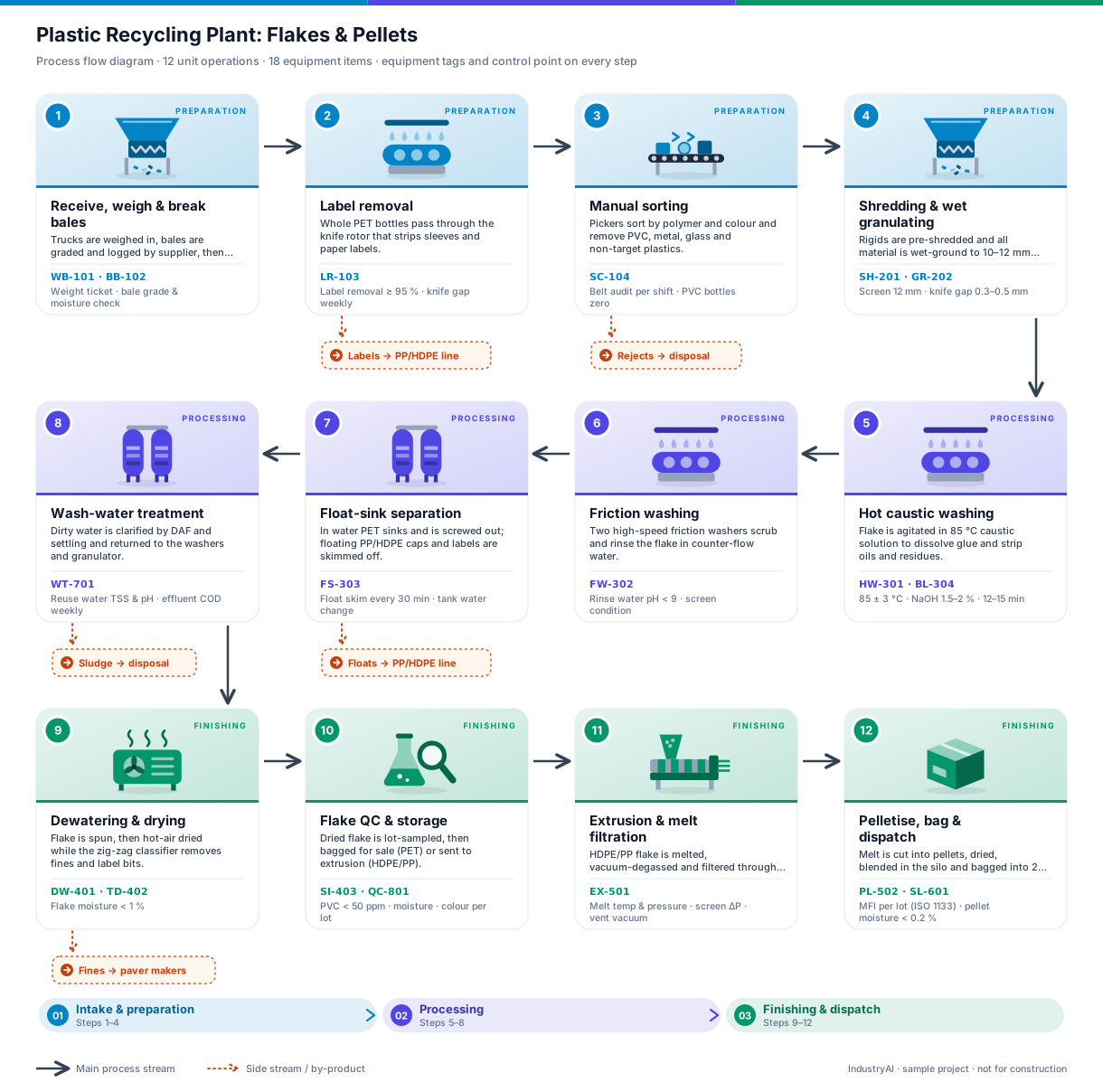
12 unit operations in order, with the equipment that performs each and its control point.
| Step | Operation | Equipment | Control point |
|---|---|---|---|
| 01 | Receive, weigh & break balesTrucks are weighed in, bales are graded and logged by supplier, then opened in the bale breaker. | WB-101 Weighbridge & Platform ScaleBB-102 Twin-Shaft Bale Breaker |
Weight ticket · bale grade & moisture check |
| 02 | Label removalWhole PET bottles pass through the knife rotor that strips sleeves and paper labels.Labels → PP/HDPE line | LR-103 PET Label Remover |
Label removal ≥ 95 % · knife gap weekly |
| 03 | Manual sortingPickers sort by polymer and colour and remove PVC, metal, glass and non-target plastics.Rejects → disposal | SC-104 Manual Sorting Conveyor (Picking Line) |
Belt audit per shift · PVC bottles zero |
| 04 | Shredding & wet granulatingRigids are pre-shredded and all material is wet-ground to 10–12 mm flake. | SH-201 Single-Shaft ShredderGR-202 Wet Granulator (Crusher) |
Screen 12 mm · knife gap 0.3–0.5 mm |
| 05 | Hot caustic washingFlake is agitated in 85 °C caustic solution to dissolve glue and strip oils and residues. | HW-301 Hot Caustic WasherBL-304 Biomass Steam Boiler |
85 ± 3 °C · NaOH 1.5–2 % · 12–15 min |
| 06 | Friction washingTwo high-speed friction washers scrub and rinse the flake in counter-flow water. | FW-302 High-Speed Friction Washer |
Rinse water pH < 9 · screen condition |
| 07 | Float-sink separationIn water PET sinks and is screwed out; floating PP/HDPE caps and labels are skimmed off.Floats → PP/HDPE line | FS-303 Float-Sink Separation Tank |
Float skim every 30 min · tank water change |
| 08 | Wash-water treatmentDirty water is clarified by DAF and settling and returned to the washers and granulator.Sludge → disposal | WT-701 Wash-Water Treatment (DAF & Settling) |
Reuse water TSS & pH · effluent COD weekly |
| 09 | Dewatering & dryingFlake is spun, then hot-air dried while the zig-zag classifier removes fines and label bits.Fines → paver makers | DW-401 Dewatering CentrifugeTD-402 Hot-Air Pipe Dryer & Zig-Zag Separator |
Flake moisture < 1 % |
| 10 | Flake QC & storageDried flake is lot-sampled, then bagged for sale (PET) or sent to extrusion (HDPE/PP). | SI-403 Flake Buffer Silo & Big-Bag FillerQC-801 QC Lab (MFI, Moisture, Contamination) |
PVC < 50 ppm · moisture · colour per lot |
| 11 | Extrusion & melt filtrationHDPE/PP flake is melted, vacuum-degassed and filtered through a continuous screen changer. | EX-501 Single-Screw Degassing Extruder |
Melt temp & pressure · screen ΔP · vent vacuum |
| 12 | Pelletise, bag & dispatchMelt is cut into pellets, dried, blended in the silo and bagged into 25 kg or 1 t lots. | PL-502 Water-Ring Pelletiser & Pellet DewateringSL-601 Pellet Silo & Jumbo-Bag Filling Station |
MFI per lot (ISO 1133) · pellet moisture < 0.2 % |
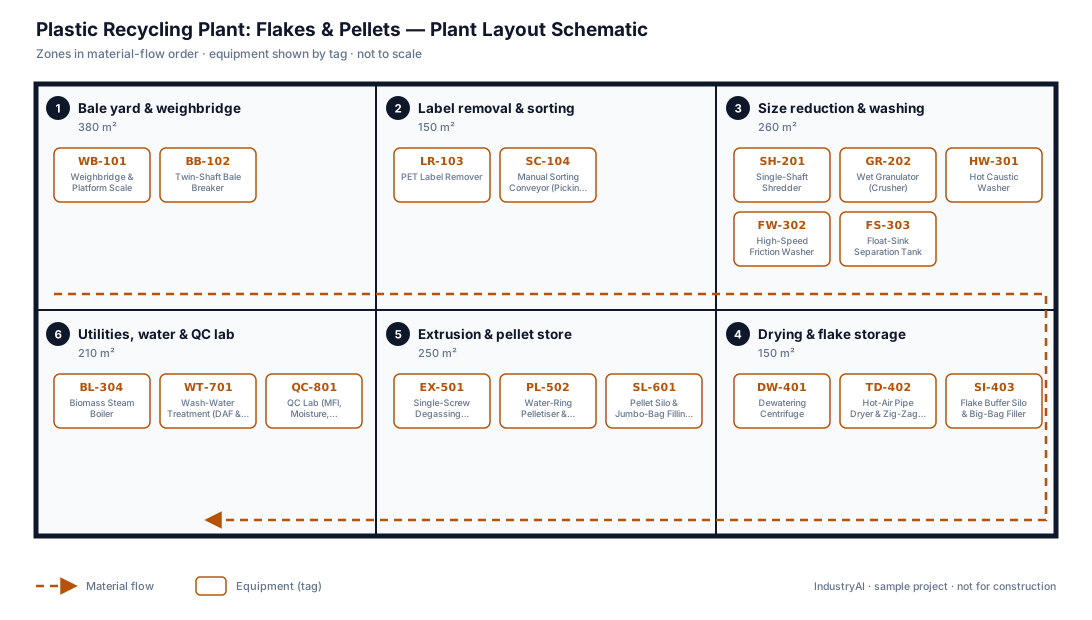
6 zones arranged for one-way material flow, with every item of equipment placed by tag.
DAF and settling return over 85 % of wash water, cutting make-up to about 1.5–2 m³ per tonne.
PET and HDPE/PP run in campaigns, and PET-line caps and labels feed the pellet line.
Double vacuum venting and a continuous screen changer give low-gel pellets without stopping to change screens.
A biomass steam boiler heats the hot washer for a fraction of the cost of electric heating.
Every jumbo bag carries a lot code linked to its supplier bales and lab results.
Weighbridge tickets and mass-balance records support recycling credits under PRO schemes.
The core routines operators follow, from start-up to batch release.
7 sections: open any one to read it, or download the whole document.
Mzunguko Polymers Ltd is a plastic recycling plant in Athi River, Machakos County, processing 1 tonne per hour of post-consumer PET bottles and HDPE/PP rigid plastics. A hot-wash line produces clean PET flake for fibre, strapping and export buyers, while a degassing extruder turns HDPE/PP flake into recycled pellets for Kenyan converters. The plant buys from its own buy-back centres, aggregators and EPR-funded collection schemes.
| Metric | Value |
|---|---|
| Input Capacity | 1 t/h · ≈ 400 t/month (2 shifts) |
| Output | ≈ 310 t/month flakes + pellets (≈ 78% yield) |
| Annual Revenue (Year 1) | KES 194,000,000 (~$1.49M) |
| Initial Investment | KES 75,000,000 (~$577,000) |
| Break-even | Operating break-even Month 5; payback ≈ Month 30 |
| Employees | 42 (plus ~300 collectors in the supply network) |
| Stage | Process | Purpose | Equipment |
|---|---|---|---|
| 1 | Weighing & Bale Breaking | Pay by net weight, open bales | 30 t weighbridge, twin-shaft bale breaker |
| 2 | Label Removal | Strip sleeves and paper labels | PET label remover (≥ 95% removal) |
| 3 | Manual Sorting | Separate by polymer and colour, remove PVC and metal | 12 m picking line, 8 stations |
| 4 | Shredding & Granulating | Reduce to 10–12 mm flake | Single-shaft shredder, wet granulator |
| 5 | Hot Washing | Dissolve glue, remove oils and residues | Caustic washer at 85 °C, biomass boiler |
| 6 | Friction Washing | Scrub and rinse off caustic | 2 high-speed friction washers |
| 7 | Float-Sink Separation | PET sinks, PP/HDPE caps float | 2 separation tanks |
| 8 | Dewatering & Drying | Moisture below 1%, remove fines | Centrifuge, hot-air dryer, zig-zag classifier |
Feedstock is the main cost (about 58% of operating spend), so the plant runs a mix of its own collection points, aggregator contracts and producer-funded schemes to keep supply steady and prices predictable.
| Source | Share of Input | Price Paid (KES/kg) | Notes |
|---|---|---|---|
| Own buy-back centres (6 in Nairobi estates) | 30% | 15–25 (loose) | Cash or M-Pesa to waste pickers; baled on site |
| Aggregators & dealers | 40% | 30–38 (baled, delivered) | Graded bales under supply contracts with quality penalties |
| EPR / PRO schemes (e.g. KEPRO) | 15% | 25–32 + recycling credit | Producer-funded collection; credits per tonne recycled |
| Hotels, malls, institutions | 10% | 10–20 | Source-separated bottles under collection agreements |
| Post-industrial scrap | 5% | 40–60 | Clean HDPE/PP regrind from converters |
| Parameter | PET Bottle Bale | HDPE/PP Rigid Bale |
|---|---|---|
| Target polymer | ≥ 90% | ≥ 85% |
| PVC | 0 visible items | 0 visible items |
| Moisture & free liquids | < 5% | < 5% |
| Non-plastics (stones, metal, paper) | < 3% | < 5% |
| Bale weight | 200–400 kg | 150–300 kg |
| Licence / Obligation | Authority / Law | Timeline | Cost (KES) |
|---|---|---|---|
| EIA Licence (full study report) | NEMA, under EMCA 1999 | 3–4 months | 0.1% of project cost + ~350,000 expert fees |
| Licence to Operate a Waste Recycling Facility | NEMA, Sustainable Waste Management Act 2022 | 1–2 months | ~50,000/year |
| Waste Transport Licences (per truck) | NEMA | 1 month | ~15,000 per truck/year |
| Effluent Discharge Licence | NEMA, Water Quality Regulations | 1–2 months | ~30,000/year |
| EPR registration & reporting | NEMA, EPR Regulations 2024 (via PROs) | 1 month | Membership fee |
| Workplace Registration & boiler certificate | DOSHS, OSHA 2007 | 1 month | ~40,000 |
| Single Business Permit | Machakos County | 2 weeks | ~60,000/year |
| Parameter | PET Flake (hot-washed) | rHDPE / rPP Pellets | Frequency |
|---|---|---|---|
| Moisture | < 1% | < 0.2% | Every lot |
| PVC content | < 50 ppm | — | Every lot |
| PP/PE content | < 100 ppm | — | Every lot |
| Labels / paper / glue | < 20 ppm | — | Every lot |
| Metal | < 20 ppm | No visible specks | Every lot |
| Melt flow index (ISO 1133) | — | HDPE 0.3–1 · PP 8–20 g/10 min | Every lot |
| Intrinsic viscosity | ≥ 0.72 dl/g | — | Monthly (external lab) |
Scope note: Flake and pellets are sold for non-food applications. Food-contact rPET would need an additional decontamination (super-clean) stage and regulatory approval.
| Item | Cost (KES) | ~US$ |
|---|---|---|
| Washing line (bale breaker to dryer, incl. boiler) | 21,250,000 | 163,500 |
| Extrusion & pelletising line with pellet silo | 15,200,000 | 117,000 |
| Wash-water treatment (DAF, settler, filter press) | 4,950,000 | 38,000 |
| Weighbridge & QC lab | 3,250,000 | 25,000 |
| Freight, clearance & installation | 6,500,000 | 50,000 |
| Civil works (floors, drains, sumps, bale yard roof) | 8,500,000 | 65,400 |
| Power connection & 630 kVA transformer | 5,000,000 | 38,500 |
| Forklift & collection truck | 4,500,000 | 34,600 |
| Licences, EIA & commissioning | 1,350,000 | 10,400 |
| Working capital (1 month of feedstock) | 4,500,000 | 34,600 |
| Total | 75,000,000 | ~577,000 |
| Product | Volume (t/month) | Price (KES/kg) | Revenue (KES) |
|---|---|---|---|
| Hot-washed PET flake | 190 | 72 | 13,680,000 |
| rHDPE / rPP pellets | 110 | 108 | 11,880,000 |
| Mixed flake & fines (paver makers) | 10 | 20 | 200,000 |
| EPR recycling credits | 300 | 4 | 1,200,000 |
| Total | 310 | — | 26,960,000 (~$207,000) |
| Item | Monthly (KES) |
|---|---|
| Feedstock (400 t at ~KES 32/kg) | 12,800,000 |
| Electricity (~140,000 kWh) | 3,360,000 |
| Biomass fuel, caustic, detergent, DAF chemicals | 1,150,000 |
| Staff salaries (42 employees) | 1,700,000 |
| Collection logistics & buy-back centres | 1,100,000 |
| Rent & rates | 600,000 |
| Maintenance, knives & screens | 550,000 |
| Sludge disposal, licences & insurance | 350,000 |
| Admin, sales & marketing | 400,000 |
| Total Monthly OPEX | 22,010,000 (~$169,000) |
| Year | Utilisation | Revenue (KES) | EBITDA (KES) | EBITDA Margin |
|---|---|---|---|---|
| Year 1 | 60% | 194,000,000 (~$1.49M) | 19,600,000 | 10% |
| Year 2 | 80% | 259,000,000 (~$1.99M) | 39,500,000 | 15% |
| Year 3 | 90% | 291,000,000 (~$2.24M) | 49,400,000 | 17% |
Payback: cumulative EBITDA covers the KES 75M investment around Month 30 (pre-tax).
Industry estimates put Kenya's plastic waste at 0.5–1 million tonnes a year, with formal recycling below 10%. The Sustainable Waste Management Act 2022 and the 2024 EPR Regulations now make producers pay for collection and recycling of their packaging, which lifts feedstock supply and adds a per-tonne credit for accredited recyclers. Demand for recycled resin is rising as converters seek cheaper alternatives to imported virgin polymer (KES 180–220/kg) and brand owners set recycled-content targets.
| Tier | Definition | Value (KES) |
|---|---|---|
| TAM | East African demand for recycled PET, HDPE and PP (flake + pellet) | 25 billion |
| SAM | Nairobi / Athi River converters, fibre makers and PET flake export | 6 billion |
| SOM (Year 3) | Mzunguko share at ~5% of SAM (≈ 3,350 t/year) | 291 million |
| Segment | Product | Use | Share of Revenue |
|---|---|---|---|
| Polyester fibre & strapping makers | PET flake | Pillow/mattress fill, strapping, sheet | 30% |
| Export buyers (India, Middle East) | PET flake | Fibre and sheet | 20% |
| Household goods & crate moulders | rPP / rHDPE pellets | Buckets, basins, crates, chairs | 30% |
| Pipe, conduit & jerrican makers | rHDPE pellets | Non-pressure pipe, conduit, jerricans | 15% |
| Paver makers & EPR credits | Mixed flake, credits | Pavers, PRO payments | 5% |
| Player | Positioning | Weakness |
|---|---|---|
| Established pellet recyclers (e.g. Mr. Green Africa) | Traceable rHDPE/rPP for brand owners | Capacity booked by large contracts |
| Informal grinding yards | Unwashed regrind at low prices | High contamination, no MFI data, no licences |
| PET flake exporters | Cold-washed flake to Asia | Lower grade, price-taker on export markets |
| Paver and lumber makers | Mixed plastics into building products | Low-value outlet, compete for feedstock |
Mzunguko differentiation: hot-washed flake and filtered, degassed pellets with a lab certificate for every lot, plus EPR-grade traceability from bale to bag that brand owners and PROs can audit.
| Month | Milestone | Owner | Dependency |
|---|---|---|---|
| M1 | Lease industrial site, submit EIA study report | MD | Site with water, sewer and 3-phase power |
| M2 | Equipment order (30% deposit), power upgrade application | MD | Financing closed |
| M3–M4 | Civil works: floors, drains, sumps, DAF tanks, bale yard roof | Plant Manager | EIA licence issued |
| M3–M5 | Open 6 buy-back centres, sign aggregator and PRO contracts | Procurement Lead | Waste transport licences |
| M5 | Equipment arrives; installation with supplier engineers | Plant Manager | Transformer energised |
| M6 | Commissioning trials, recycling facility and effluent licences | Plant Manager | NEMA inspection |
| M7 | Commercial production at 50%, first customer lots approved | Sales Lead | Customer trial results |
| M12 | Two-shift operation at 70–80% utilisation | MD | Feedstock at 300+ t/month |
| Risk | Impact | Mitigation |
|---|---|---|
| Feedstock shortage or price spikes | High | Own buy-back centres, PRO contracts, one week of bale stock |
| Contaminated bales lowering yield | High | Bale grading at the weighbridge, price penalties, supplier training |
| Recycled resin prices fall with oil and virgin prices | Medium | Lot-quality premium, domestic customers on 6-month price bands |
| Power outages and tariff increases | Medium | Genset for safe extruder shutdown, off-peak scheduling, rooftop solar in Year 2 |
| Effluent non-compliance | High | DAF and settling, weekly COD/TSS tests, licensed sludge handler |
| Shredder, granulator and caustic accidents | High | Guard interlocks, lock-out/tag-out, PPE and DOSHS training |
| Currency swings on imported equipment and spares | Medium | Fixed-price contracts, local knife sharpening, spares held on site |
Equipment specifications, process flow diagrams, recipes and the business plan, bundled as one download.
We use strictly necessary cookies to sign you in and keep the site secure. With your consent we also use functional and analytics cookies to remember your preferences and understand which features get used. We do not use advertising cookies. Read our Cookie Policy.
Declining does not limit any paid feature. Change your choice any time via "Cookie Settings" in the footer.