Fabric Inspection & Rolling Machine
Up to 2,000 mm width · back-lit table · length counter
Checks incoming fabric for faults and shade before it reaches cutting.
14 line items in process order, each with its tag, specification, quantity, power and an indicative unit price.
Up to 2,000 mm width · back-lit table · length counter
Checks incoming fabric for faults and shade before it reaches cutting.
Pattern grading & marker software · 1.8 m inkjet plotter
Grades patterns and plans markers to cut fabric waste to a minimum.
12 m × 1.8 m · air-float top section
Fabric is laid up in multi-ply spreads ready for cutting.
8-inch blade · cuts up to 180 mm lay height
Cuts multi-ply lays along the marker lines.
Direct-drive servo · auto thread trimmer
The workhorse of every line: seams, collars, plackets and hems.
Direct-drive · differential feed
Sews and neatens seams in one pass on knits and wovens.
3-needle 5-thread · cylinder bed
Hems and flat seams on T-shirts, polos and hoodies.
Electronic lockstitch buttonhole · chainstitch button sewer
Makes and attaches buttons on shirts, blouses and lab coats.
Electronic · programmable patterns
Reinforces pocket corners, belt loops and stress points on workwear.
6 heads · 12 needles each · 400 × 500 mm field
Stitches school crests and corporate logos in-house.
40 × 50 cm platen · pneumatic
Applies printed transfers and care labels on T-shirts and polos.
Vacuum + blowing table · steam iron · 24 kW boiler (shared)
Presses finished garments before folding and packing.
Detects 1.0 mm iron ball · auto-stop conveyor
Checks every packed garment for broken needle fragments, a buyer requirement.
Folding boards · poly-bag sealer · carton scale
Garments are folded, bagged, size-labelled and cartoned.
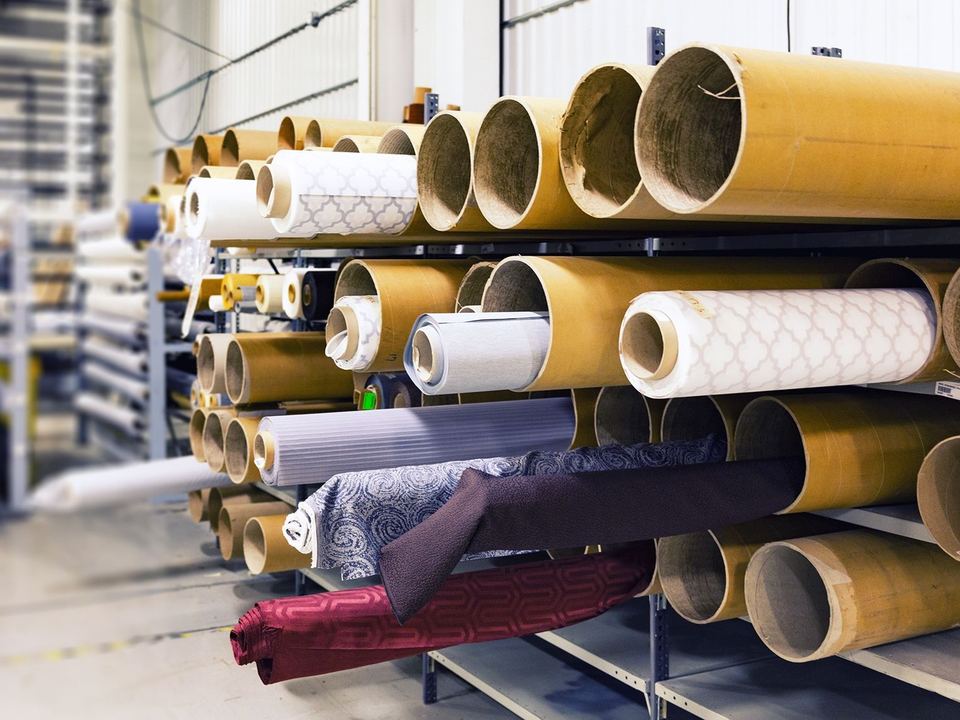
Indicative ex-works prices (US$, 2026) for budgeting a sample project, not quotations. Photos are illustrative of each machine class.
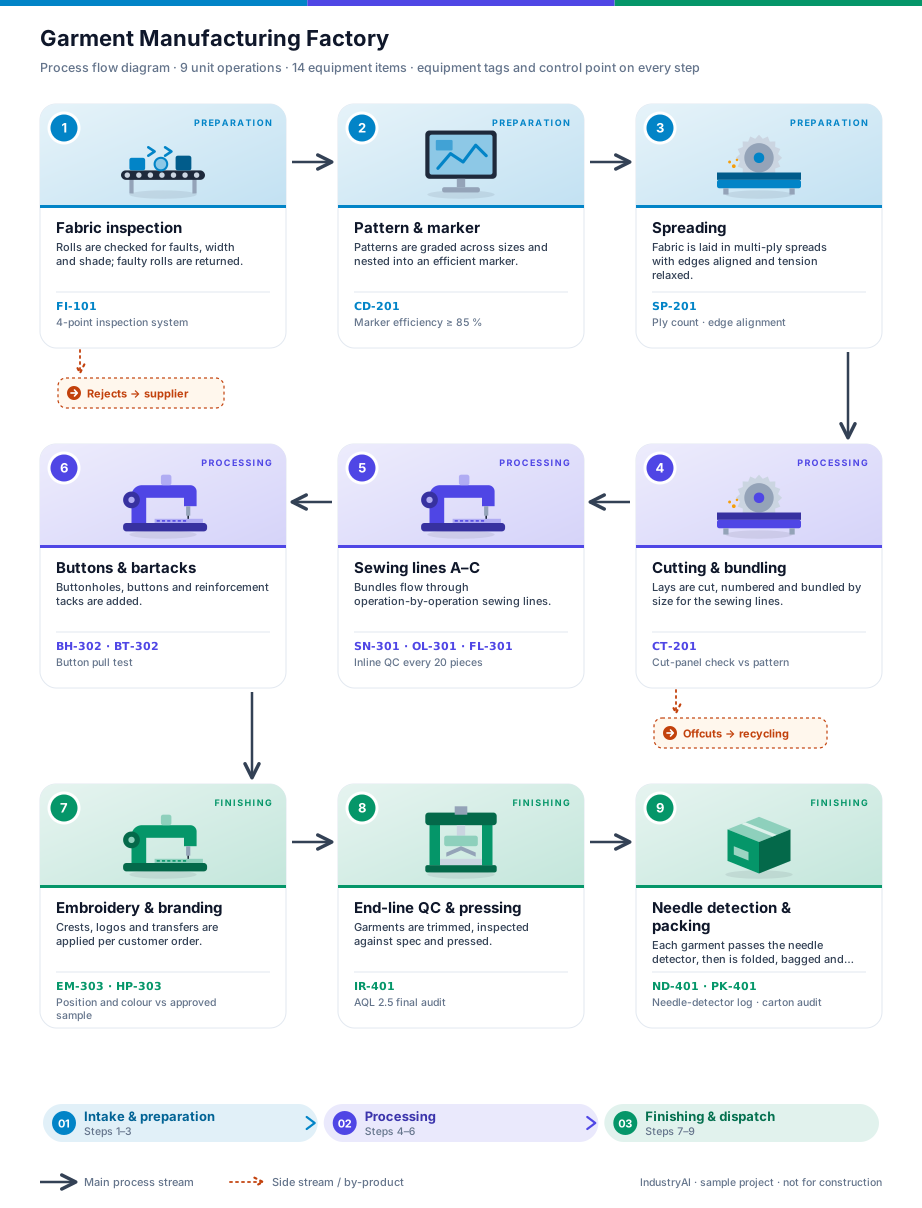
9 unit operations in order, with the equipment that performs each and its control point.
| Step | Operation | Equipment | Control point |
|---|---|---|---|
| 01 | Fabric inspectionRolls are checked for faults, width and shade; faulty rolls are returned.Rejects → supplier | FI-101 Fabric Inspection & Rolling Machine |
4-point inspection system |
| 02 | Pattern & markerPatterns are graded across sizes and nested into an efficient marker. | CD-201 CAD Pattern System & Plotter |
Marker efficiency ≥ 85 % |
| 03 | SpreadingFabric is laid in multi-ply spreads with edges aligned and tension relaxed. | SP-201 Spreading & Cutting Tables |
Ply count · edge alignment |
| 04 | Cutting & bundlingLays are cut, numbered and bundled by size for the sewing lines.Offcuts → recycling | CT-201 Straight-Knife Cutting Machine |
Cut-panel check vs pattern |
| 05 | Sewing lines A–CBundles flow through operation-by-operation sewing lines. | SN-301 Single-Needle Lockstitch MachineOL-301 Overlock Machine (4-thread)FL-301 Flatlock / Coverstitch Machine |
Inline QC every 20 pieces |
| 06 | Buttons & bartacksButtonholes, buttons and reinforcement tacks are added. | BH-302 Buttonhole & Button-Attach MachinesBT-302 Bartack Machine |
Button pull test |
| 07 | Embroidery & brandingCrests, logos and transfers are applied per customer order. | EM-303 Multi-Head Embroidery MachineHP-303 Heat Transfer Press |
Position and colour vs approved sample |
| 08 | End-line QC & pressingGarments are trimmed, inspected against spec and pressed. | IR-401 Vacuum Ironing Tables & Steam Boiler |
AQL 2.5 final audit |
| 09 | Needle detection & packingEach garment passes the needle detector, then is folded, bagged and cartoned. | ND-401 Conveyor Needle DetectorPK-401 Folding & Packing Stations |
Needle-detector log · carton audit |
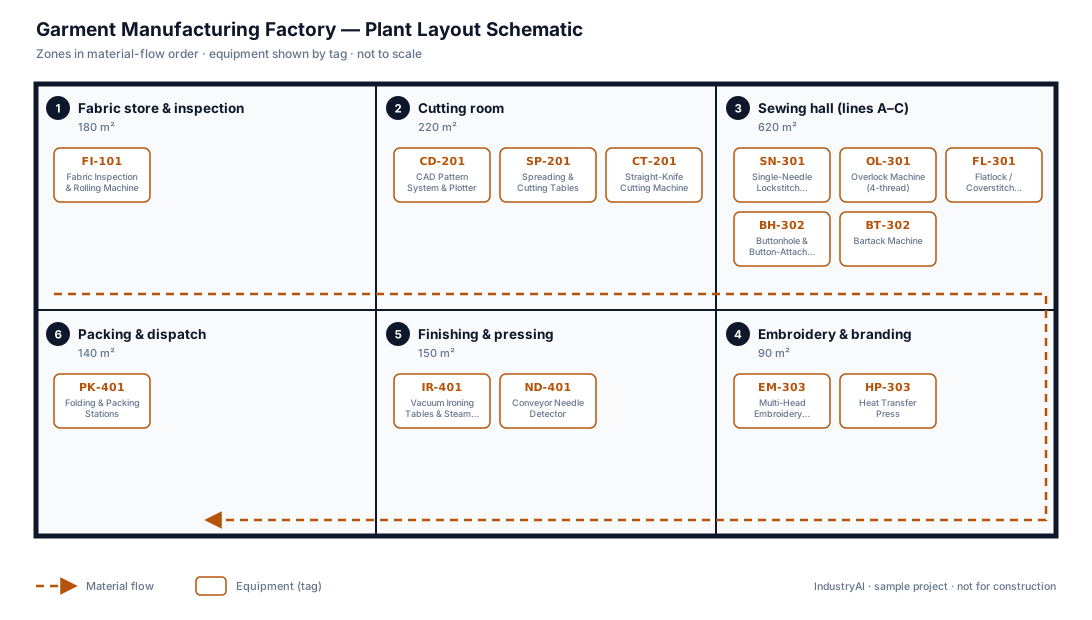
6 zones arranged for one-way material flow, with every item of equipment placed by tag.
Computer-nested markers save 5–8 % of fabric, the largest cost in each garment.
Direct-drive sewing heads use up to 70 % less power than clutch motors.
Uniforms, workwear and basics run in parallel without changeovers.
Embroidery and heat transfer keep logo work and lead times under your control.
AQL audits and needle detection meet international buyer requirements.
Fabric enters one end and cartons leave the other, with no back-tracking.
The core routines operators follow, from start-up to batch release.
11 sections: open any one to read it, or download the whole document.
AfriThreads Manufacturing is a garment factory in Nairobi's Export Processing Zone producing school uniforms, corporate workwear, and basic fashion items. The factory has capacity for 5,000 pieces per day with 120 industrial sewing machines and 180 workers.
| Metric | Value |
|---|---|
| Factory Size | 15,000 sq ft |
| Daily Capacity | 5,000 pieces |
| Initial Investment | $350,000 |
| Year 1 Revenue | $1,200,000 |
| Year 3 Revenue | $3,600,000 |
| Employees | 180 |
| Line | Products | Machines | Workers | Daily Output |
|---|---|---|---|---|
| Line A: Uniforms | School shirts, trousers, skirts | 40 machines | 60 | 2,000 pieces |
| Line B: Workwear | Corporate shirts, overalls, lab coats | 30 machines | 45 | 1,500 pieces |
| Line C: Fashion Basics | T-shirts, polo shirts, hoodies | 30 machines | 45 | 1,500 pieces |
| Cutting Section | Fabric cutting for all lines | CAD cutter + manual | 15 | All lines |
| Quality & Finishing | QC, ironing, packaging | Various | 15 | All lines |
| Cost Component | Cost/Unit (KES) | % of Total |
|---|---|---|
| Fabric (1.5m polycotton) | 120 | 40% |
| Buttons, thread, labels | 25 | 8% |
| Direct labor (cutting + sewing) | 45 | 15% |
| Factory overheads | 35 | 12% |
| Quality control & finishing | 15 | 5% |
| Packaging | 10 | 3% |
| Total Production Cost | 250 | 83% |
| Wholesale Price | 350 | -- |
| Margin per Unit | 100 (29%) | -- |
| Metric | Year 1 | Year 2 | Year 3 |
|---|---|---|---|
| Units Produced | 1,000,000 | 1,500,000 | 2,200,000 |
| Revenue | $1,200,000 | $2,100,000 | $3,600,000 |
| COGS (65%) | $780,000 | $1,344,000 | $2,268,000 |
| Gross Profit | $420,000 | $756,000 | $1,332,000 |
| Operating Expenses | $300,000 | $432,000 | $648,000 |
| Net Profit | $120,000 | $324,000 | $684,000 |
East Africa's apparel manufacturing benefits from AGOA duty-free access to the US, preferential EU trade under EBA, and growing regional demand from school uniforms and corporate workwear. Kenya's apparel exports reached $540 million in 2024, up 14% YoY, with EPZ-based factories enjoying corporate-tax holidays.
| Tier | Definition | Value |
|---|---|---|
| TAM | East African school uniforms + workwear + basics | $1.8B |
| SAM | Kenya uniforms + corporate + EU/US export | $420M |
| SOM (Year 3) | AfriThreads target share | $3.6M (0.85% of SAM) |
| Competitor | Focus | Strength | Gap We Exploit |
|---|---|---|---|
| United Aryan | EPZ export to US (jeans) | Scale (~5M pcs/yr) | No domestic uniform line |
| Hela Apparel | EPZ knit + woven | Diversified buyers | Minimum-order too high for SMEs |
| Imported (China) | Mass uniforms | Lowest price | Lead time 8-10 weeks; quality issues |
| Local cottage tailors | Custom uniforms | Speed for small batches | Cannot scale beyond ~200 pcs/week |
AfriThreads differentiation: Mid-sized (5K/day) factory able to take 500-piece orders that EPZ majors reject, with consistent quality, 3-week lead time, and dual domestic + export licensing.
| Segment | % Revenue | Notes |
|---|---|---|
| Domestic Uniforms (schools) | 40% | 50+ schools direct + 3 distributors |
| Corporate Workwear (Kenya) | 25% | Banks, hospitals, hotels, security firms |
| Regional Export (Uganda, Rwanda) | 20% | EAC tariff-free; 2 wholesale buyers in Kampala |
| Private Label (US/EU) | 15% | Through AGOA buying houses |
| Certification / Audit | Authority | Why | Cost (USD) |
|---|---|---|---|
| WRAP Gold | Worldwide Responsible Accredited Production | Required by most US apparel buyers | 8,500 (annual) |
| SEDEX SMETA 4-Pillar | SEDEX | Required by UK / EU retailers | 3,200 (biennial) |
| BSCI | amfori BSCI | European retailer preference | 2,800 (biennial) |
| EPZ Operating Licence | EPZ Authority | Duty-free + tax holiday eligibility | 1,500/year |
| OEKO-TEX Standard 100 | OEKO-TEX | Fabric safety for children's wear | 3,000 (per fabric class) |
| ISO 9001 (Year 2) | Accredited CB | Quality management credential | 4,000 initial |
| Department | Roles | Headcount | Monthly (USD) |
|---|---|---|---|
| Production Floor | Sewing operators, helpers | 150 | 22,500 |
| Cutting | CAD operator, cutters, spreaders | 15 | 3,750 |
| Quality & Finishing | QC inspectors, finishers, packers | 15 | 3,750 |
| Maintenance | Mechanic, electrician | 2 | 800 |
| Management | GM, Production Manager, Merchandiser | 3 | 4,500 |
| Sales & BD | BD reps (domestic + export) | 3 | 2,100 |
| Support | HR, accountant, security, drivers | 5 | 1,800 |
| Total | — | 193 | $39,200 |
Training: 30-day onboarding for new operators (industrial machine certification + safety). Cross-skill targets: 70% of operators trained on at least 2 machine types within 12 months to enable line balancing.
| Phase | Months | Milestones |
|---|---|---|
| Setup | M1-M3 | EPZ lease secured · machinery order placed (China + India) · WRAP/SEDEX audit prep |
| Build | M4-M6 | Factory fit-out · machinery installation · staff recruitment (180) · training rollout |
| Pilot | M7-M8 | Trial production (500 pcs/day) · QC system live · WRAP audit · first domestic order |
| Ramp-up | M9-M12 | 3,000 pcs/day · 5 school customers · first regional export shipment |
| Scale | M13-M18 | 5,000 pcs/day · SEDEX audit · first US private-label order via buying house |
| Diversify | M19-M24 | Add knit line (T-shirts) · ISO 9001 · second shift |
| Risk | Likelihood | Impact | Mitigation |
|---|---|---|---|
| AGOA non-renewal post-2025 | Low-Medium | High | Diversify to EU (EBA), domestic, and regional EAC — keep US < 30% of revenue |
| Fabric import delay (Mombasa port) | High | Medium | 8-week safety stock for top 5 fabrics; dual sourcing from India + China |
| Industrial action / strike | Medium | High | CBA with COTU-affiliated union; staff welfare committee; productivity bonuses |
| Buyer order cancellation | Medium | High | Letter of Credit on exports > $50K; advance deposit on domestic; diversified buyer base |
| Quality rejection by overseas buyer | Low | High | Pre-shipment 3rd-party inspection; AQL 2.5 sampling; insurance on shipped goods |
| FX volatility (KES vs USD) | High | Medium | Export contracts priced in USD; natural hedge through USD-denominated fabric purchases |
Total Ask: $350,000 — founder equity ($150K) + DFI loan ($150K, KAM Industrial Loan or AfDB SME line) + trade finance line ($50K).
| Category | Amount | % |
|---|---|---|
| Industrial sewing machines (120 units, mixed types) | $140,000 | 40% |
| Cutting + finishing equipment (CAD spreader, fusing, ironing) | $45,000 | 13% |
| Factory fit-out + EPZ deposit | $60,000 | 17% |
| Initial fabric inventory (3 months) | $55,000 | 16% |
| Working capital + payroll buffer | $35,000 | 10% |
| Certifications + audits (WRAP, SEDEX, OEKO-TEX) | $15,000 | 4% |
| Metric | Year 1 | Year 2 | Year 3 |
|---|---|---|---|
| Net Profit | $120,000 | $324,000 | $684,000 |
| Return on Equity | 80% | 116% | 147% |
Exit: Investor IRR ~41% over 5 years via trade sale to a regional apparel group or PE buyer at 4x EBITDA.
Equipment specifications, process flow diagrams, recipes and the business plan, bundled as one download.
We use strictly necessary cookies to sign you in and keep the site secure. With your consent we also use functional and analytics cookies to remember your preferences and understand which features get used. We do not use advertising cookies. Read our Cookie Policy.
Declining does not limit any paid feature. Change your choice any time via "Cookie Settings" in the footer.