Harvest Tools & Field Shade Kit
60 clippers · 30 picking poles · 60 harvest bags · 20 shade canopies
Lets picking teams cut fruit with a short stalk and keep full crates out of the sun.
18 line items in process order, each with its tag, specification, quantity, power and an indicative unit price.
60 clippers · 30 picking poles · 60 harvest bags · 20 shade canopies
Lets picking teams cut fruit with a short stalk and keep full crates out of the sun.
20 kg · food-grade HDPE · vented sides · stackable, colour-coded
Carries fruit from tree to packhouse without bruising and lets cold air through in the pre-cooler.
1,500 kg platform · 0.5 kg resolution · thermal barcode printer
Weighs every delivery and prints a barcode lot label tying the crates to grower and block.
8 pallets per tunnel · 25 °C → 8–10 °C pulp in ≈ 6 h · R404A/R449A
Pulls chilled air through stacked crates to strip field heat before the fruit is handled.
Hydraulic crate tipper · 4 m³ SS304 tank · sanitiser dosing port
Floats fruit out of the crates into sanitised water so it enters the line without drops.
3 m · 12 soft nylon brushes · overhead spray bars · 3 t/h
Rotating brushes and fresh-water sprays remove soil, sap and latex from the skin.
2 t/batch · 46.1 °C ± 0.3 °C · 120 kW LPG heater · 8-probe chart recorder
Holds mango pulp at the fruit-fly protocol temperature for a recorded time before cool-down.
4 m roller bed · 2 blowers + air knives · ambient or warm air
Blows free water off the fruit so coatings stick and no moisture goes into the carton.
Low-volume spinning-disc nozzles · horsehair brush bed · dose meter
Applies a thin, buyer-approved carnauba or plant-based coating to cut moisture loss.
2 lanes · 2.5 t/h · camera weight, colour & blemish grading · 10 drops
Photographs and weighs every fruit, then drops it at the outlet for its size count and class.
SS-top table · 15 kg check scale · PLU sticker dispenser
Each packer fills, check-weighs and stickers 4 kg cartons at a padded station.
Hot-melt tray former · 12 trays/min · GS1 case label printer-applicator
Forms open-top export trays and labels each with grower lot, count and pack date.
Semi-auto PP strapper · 4 straps/pallet · ISPM-15 pallet stock
Squares each 1.2 m pallet with corner boards and straps it for reefer transit.
40 pallets each · 100 mm PIR panels · 5–7 °C / 10–12 °C · 90–95 % RH
Holds packed avocado and mango at their own set-points until the reefer is loaded.
2 t · 4.5 m lift · cold-store rated · lithium-ion battery
Moves pallets from the strapper into the cold rooms and onto the reefer without fumes.
Hydraulic 6 t leveller · inflatable seal shelter · wheel chock
Seals the reefer door to the cold-room dock so the cold chain is never broken at loading.
Drying oven · 0.01 g balance · penetrometer · Brix meter · residue sample kit
Tests avocado dry matter and firmness, mango Brix and pulp temperature, and bags residue samples.
Screen + sand filter · 10 m³ settling tank · chlorine/PAA dosing · ORP probe
Filters and re-sanitises dump-tank water for reuse and treats blowdown before discharge.
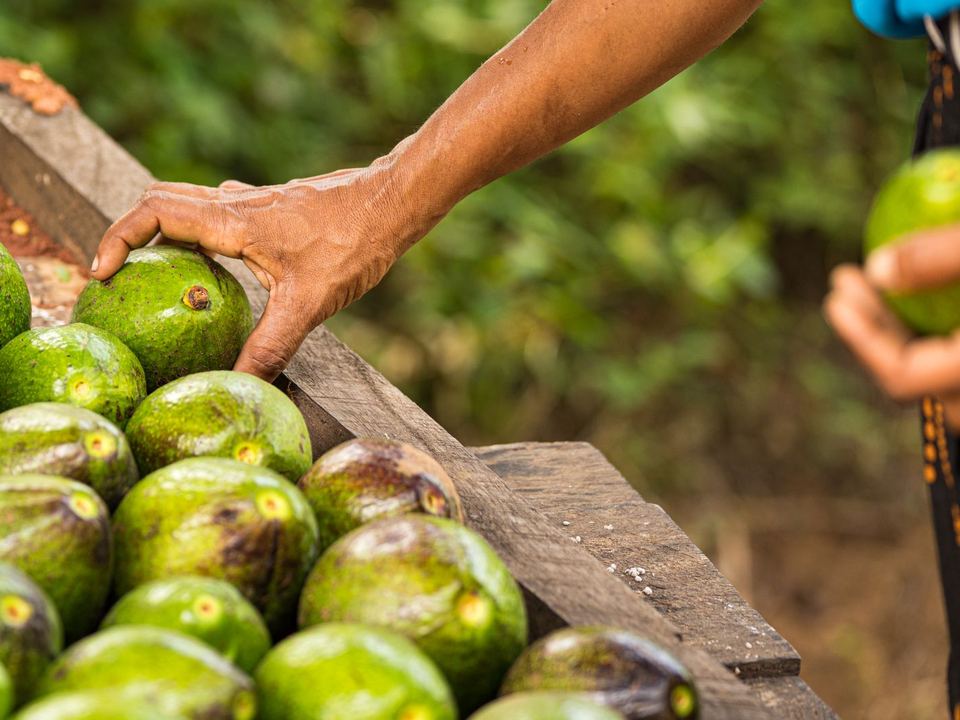
Indicative ex-works prices (US$, 2026) for budgeting a sample project, not quotations. Photos are illustrative of each machine class.
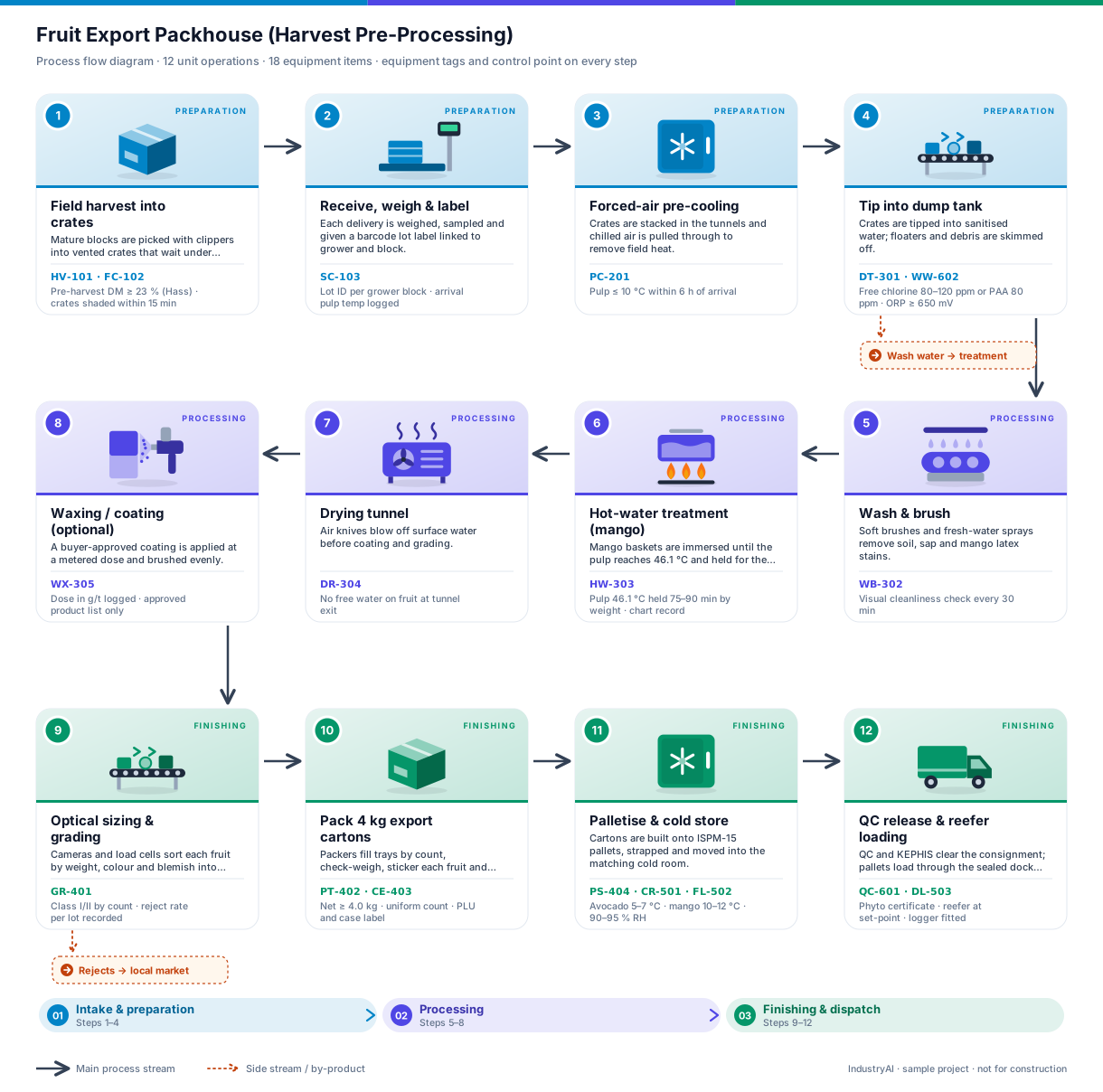
12 unit operations in order, with the equipment that performs each and its control point.
| Step | Operation | Equipment | Control point |
|---|---|---|---|
| 01 | Field harvest into cratesMature blocks are picked with clippers into vented crates that wait under field shade. | HV-101 Harvest Tools & Field Shade KitFC-102 Ventilated Field Crates |
Pre-harvest DM ≥ 23 % (Hass) · crates shaded within 15 min |
| 02 | Receive, weigh & labelEach delivery is weighed, sampled and given a barcode lot label linked to grower and block. | SC-103 Platform Scales & Lot Label Printer |
Lot ID per grower block · arrival pulp temp logged |
| 03 | Forced-air pre-coolingCrates are stacked in the tunnels and chilled air is pulled through to remove field heat. | PC-201 Forced-Air Pre-Cooling Tunnel |
Pulp ≤ 10 °C within 6 h of arrival |
| 04 | Tip into dump tankCrates are tipped into sanitised water; floaters and debris are skimmed off.Wash water → treatment | DT-301 Crate Tipper & Water Dump TankWW-602 Wash-Water Filter & Dosing Unit |
Free chlorine 80–120 ppm or PAA 80 ppm · ORP ≥ 650 mV |
| 05 | Wash & brushSoft brushes and fresh-water sprays remove soil, sap and mango latex stains. | WB-302 Spray Washer & Brush Bed |
Visual cleanliness check every 30 min |
| 06 | Hot-water treatment (mango)Mango baskets are immersed until the pulp reaches 46.1 °C and held for the protocol time. | HW-303 Hot-Water Quarantine Treatment Tank |
Pulp 46.1 °C held 75–90 min by weight · chart record |
| 07 | Drying tunnelAir knives blow off surface water before coating and grading. | DR-304 Air-Knife Drying Tunnel |
No free water on fruit at tunnel exit |
| 08 | Waxing / coating (optional)A buyer-approved coating is applied at a metered dose and brushed evenly. | WX-305 Wax & Coating Applicator |
Dose in g/t logged · approved product list only |
| 09 | Optical sizing & gradingCameras and load cells sort each fruit by weight, colour and blemish into count and class drops.Rejects → local market | GR-401 Optical Sizing & Grading Line |
Class I/II by count · reject rate per lot recorded |
| 10 | Pack 4 kg export cartonsPackers fill trays by count, check-weigh, sticker each fruit and label the carton. | PT-402 Packing Tables & Check ScalesCE-403 Carton Erector & Case Labeller |
Net ≥ 4.0 kg · uniform count · PLU and case label |
| 11 | Palletise & cold storeCartons are built onto ISPM-15 pallets, strapped and moved into the matching cold room. | PS-404 Pallet Strapping & Corner-Board StationCR-501 Export Cold RoomFL-502 Electric Forklift |
Avocado 5–7 °C · mango 10–12 °C · 90–95 % RH |
| 12 | QC release & reefer loadingQC and KEPHIS clear the consignment; pallets load through the sealed dock into a pre-cooled reefer. | QC-601 QC Lab: Dry-Matter & Residue KitDL-503 Dock Leveller & Reefer Shelter |
Phyto certificate · reefer at set-point · logger fitted |
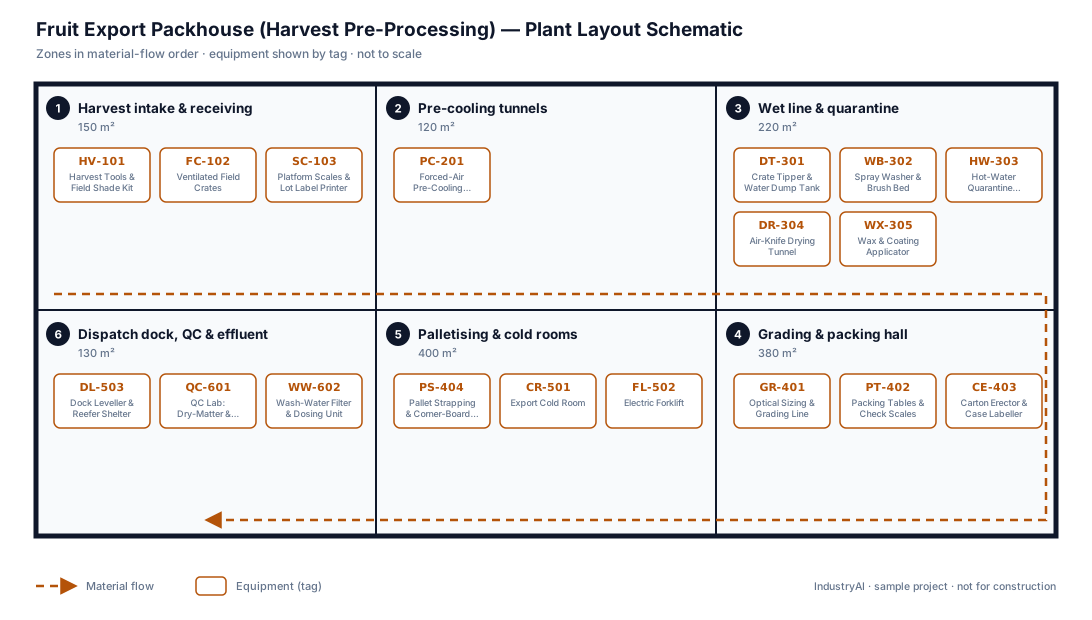
6 zones arranged for one-way material flow, with every item of equipment placed by tag.
Shaded field crates and forced-air pre-cooling pull out field heat within hours of picking.
A chart-recorded hot-water tank meets the mango fruit-fly protocol for EU and Middle East buyers.
Camera sizing packs consistent counts and classes, cutting disputes and claims at destination.
Every carton carries a lot code that traces back to the grower, block and harvest day.
Dump-tank water is filtered and re-sanitised, cutting fresh-water demand by about half.
Reefers load through an insulated dock shelter so pallets never stand in the sun.
The core routines operators follow, from start-up to batch release.
7 sections: open any one to read it, or download the whole document.
Mlima Fresh Exports Ltd is a fresh-fruit export packhouse in Thika, Kiambu County, Kenya, within 90 minutes of the Murang'a and Kiambu avocado belt and on the highway to both Jomo Kenyatta International Airport and the port of Mombasa. The packhouse receives 20 tonnes of fruit a day from contracted outgrowers, removes field heat with forced-air pre-cooling, washes, hot-water treats (mango), optically grades and packs fruit into 4 kg export cartons, and holds it at 5–12 °C until it is loaded into refrigerated containers for the EU, the Middle East and Asia. Hass avocado runs from about March to September and mango from about November to March, keeping the line busy for roughly 250 days a year.
| Metric | Value |
|---|---|
| Daily Fruit Intake | 20 tonnes (≈ 4,000 × 4 kg cartons packed) |
| Export Volume (Year 2) | ≈ 2,800 tonnes (≈ 700,000 cartons) |
| Annual Revenue (Year 1) | KES 344,000,000 (~$2,650,000) |
| Initial Investment | KES 105,000,000 (~$808,000) |
| EBITDA Margin (Year 1) | 10% |
| Break-even | Month 15 |
| Employees | 24 permanent + up to 90 seasonal |
| Stage | Process | Purpose | Equipment |
|---|---|---|---|
| 1 | Field Harvest | Pick mature fruit without bruising, keep it shaded | Clippers, poles, 20 kg vented crates, shade canopies |
| 2 | Receiving & Labelling | Weigh and assign a grower lot code | 1,500 kg platform scales + barcode printer |
| 3 | Forced-Air Pre-Cooling | Remove field heat within 6 hours | 2 tunnels × 8 pallets |
| 4 | Tipping & Dump Tank | Gentle wet entry, first sanitising wash | Hydraulic tipper + 4 m³ SS tank |
| 5 | Washing & Brushing | Remove soil, sap and latex | Spray washer with 12-brush bed |
| 6 | Hot-Water Treatment (mango) | Fruit-fly quarantine at 46.1 °C pulp | 2 t/batch tank with chart recorder |
| 7 | Drying | Remove surface water | Air-knife drying tunnel |
| 8 | Waxing / Coating | Reduce moisture loss (buyer option) | Spinning-disc applicator |
| 9 | Optical Sizing & Grading | Sort by weight, colour and blemish | 2-lane camera grader, 2.5 t/h |
| 10 | Packing | Fill 4 kg cartons by count | 12 packing stations + tray former |
| 11 | Palletising & Cold Storage | Hold at product set-point | Strapper + 2 cold rooms (80 pallets) |
| 12 | Reefer Loading | Unbroken cold chain to vessel or aircraft | Dock leveller + sealed shelter |
Mlima Fresh sources fruit from about 1,200 contracted smallholders organised in 30 producer groups, plus 5 medium-size estates that supply a guaranteed base volume. Every grower is registered with a field agent, mapped by GPS and audited under the company's GLOBALG.A.P. Option 2 group certificate.
| Fruit | Main Counties | Season | Farm-Gate Price (KES/kg) | Share of Intake |
|---|---|---|---|---|
| Hass avocado | Murang'a, Kiambu, Nyeri, Meru | Mar–Sep | 70–90 | 60% |
| Fuerte avocado | Murang'a, Embu, Kisii | Mar–Jul | 35–50 | 10% |
| Mango (Apple, Kent) | Makueni, Machakos, Kilifi | Nov–Mar | 35–55 | 30% |
| Input | Specification | Use per Tonne Packed | Cost (KES/tonne) |
|---|---|---|---|
| Export cartons | 4 kg single-layer open-top trays, 7-ply corrugated | 250 cartons | 23,000 |
| PLU stickers & case labels | Buyer-specific, GS1 barcode | ≈ 5,000 stickers | 1,500 |
| Pallets & corner boards | ISPM-15 heat-treated 1.2 × 1.0 m | ≈ 0.8 pallet | 1,800 |
| Coating (optional) | Carnauba or plant-based, EU-approved | ≈ 1 litre | 800 |
| Wash sanitiser | Sodium hypochlorite or peracetic acid | As dosed to target ppm | 300 |
| LPG (mango HWT) | Bulk 48 kg cylinders | ≈ 4 kg | 1,100 |
| Requirement | Authority | Timeline | Cost (KES) |
|---|---|---|---|
| Horticulture export licence & packhouse registration | AFA – Horticultural Crops Directorate (HCD) | 1–2 months, renewed yearly | 60,000 |
| Packhouse approval & phytosanitary certificates | KEPHIS | 2 months, then per consignment | 80,000 + per-consignment fees |
| GLOBALG.A.P. IFA (outgrower group, Option 2) | Accredited certification body | 6–9 months | 1,200,000 |
| GLOBALG.A.P. Produce Handling Assurance (packhouse) | Accredited certification body | 4–6 months | 450,000 |
| Environmental Impact Assessment & effluent licence | NEMA | 3 months | 250,000 |
| Food-handling & public health licences | Kiambu County / Ministry of Health | 1 month | 40,000 |
| Parameter | Standard | Our Target | Frequency |
|---|---|---|---|
| Hass dry matter (maturity) | ≥ 21% (UNECE FFV-42); AFA season-opening maturity checks | ≥ 23% | 10 fruit per lot, before harvest and at intake |
| Fuerte dry matter | ≥ 20% (UNECE FFV-42) | ≥ 21% | 10 fruit per lot |
| Mango HWT pulp temperature | 46.1 °C for 75–90 min by fruit weight | All probes ≥ 46.1 °C, full hold time | Every batch, chart archived |
| Pulp temperature at loading | Buyer specification | Avocado 5–7 °C, mango 10–12 °C | Every pallet |
| Class I defects | ≤ 10% by number (UNECE tolerance) | ≤ 5% | Every 30 minutes per lane |
| Net carton weight | ≥ 4.0 kg declared | 4.0–4.1 kg | 1 carton per packer every 15 min |
| Item | Cost (KES) | ~US$ |
|---|---|---|
| Grading, washing & HWT line (tipper to packing tables) | 33,000,000 | 254,000 |
| Pre-cooling tunnels & cold rooms | 17,500,000 | 135,000 |
| Field crates, harvest kit & intake scales | 4,400,000 | 34,000 |
| Forklifts, strapper, dock levellers | 8,500,000 | 65,000 |
| QC lab & wash-water treatment | 3,000,000 | 23,000 |
| Installation, freight & duties on equipment | 1,600,000 | 12,000 |
| Building fit-out, insulated panels, drainage | 17,000,000 | 131,000 |
| 250 kVA generator & power connection | 5,500,000 | 42,000 |
| Certification, licences & pre-opening | 2,500,000 | 19,000 |
| Working capital (fruit payments, cartons) | 12,000,000 | 92,000 |
| Total | 105,000,000 | 808,000 |
| Item | Year 1 (KES) | Year 2 (KES) | Year 3 (KES) |
|---|---|---|---|
| Line utilisation | 60% | 80% | 90% |
| Fruit intake (tonnes) | 2,640 | 3,520 | 3,960 |
| Export volume (tonnes) | 2,100 | 2,800 | 3,170 |
| Avocado exports (≈ KES 150/kg) | 220,500,000 | 294,000,000 | 333,000,000 |
| Mango exports (≈ KES 180/kg) | 113,400,000 | 151,200,000 | 171,000,000 |
| Grade-outs to local market | 10,100,000 | 12,800,000 | 14,000,000 |
| Total revenue | 344,000,000 | 458,000,000 | 518,000,000 |
| Fruit purchases | 174,000,000 | 232,000,000 | 261,000,000 |
| Packaging & labels | 56,000,000 | 74,000,000 | 84,000,000 |
| Labour (permanent + seasonal) | 30,000,000 | 36,000,000 | 39,000,000 |
| Energy (power, LPG, diesel) | 14,000,000 | 17,000,000 | 19,000,000 |
| Inland haulage, port & clearing | 16,000,000 | 21,000,000 | 24,000,000 |
| Compliance, testing & levies | 8,000,000 | 9,000,000 | 10,000,000 |
| Overheads & administration | 12,000,000 | 14,000,000 | 14,000,000 |
| EBITDA | 34,000,000 (10%) | 55,000,000 (12%) | 67,000,000 (13%) |
| Net profit after depreciation, interest & tax | 13,000,000 | 29,000,000 | 38,000,000 |
Payback: about 3 years on cumulative operating cash flow. Year 1 revenue equals about US$2.65 million, rising to about US$4.0 million in Year 3 at KES 130/US$.
Kenya is Africa's largest avocado exporter by volume, shipping well over 100,000 tonnes a year in recent seasons, mainly to the Netherlands, Spain, France, the UAE and Saudi Arabia, with China opening to fresh Hass under a 2022 protocol. Kenyan mango exports are smaller but growing in the Gulf and in EU niche channels, where Kenya's November–March season fills a window between West African and Latin American supply. The binding constraint for most small exporters is not demand but compliant packhouse capacity: pre-cooling, residue control and quarantine treatment that satisfy EU and protocol-market buyers.
| Tier | Definition | Value (KES) |
|---|---|---|
| TAM | Kenya fresh avocado and mango exports (all markets) | ≈ 20 billion |
| SAM | Central Kenya Hass + Eastern mango shipped by independent packhouses to EU, Gulf and Asia | ≈ 6 billion |
| SOM (Year 3) | Mlima Fresh share at ≈ 8–9% of SAM | 518 million |
| Market | Product & Mode | Share of Volume | Buyer Requirement |
|---|---|---|---|
| EU (Netherlands, Spain, France) | Hass by sea, ripe-and-ready programmes | 45% | GLOBALG.A.P., EU MRLs, dry matter ≥ 23% |
| Middle East (UAE, Saudi Arabia, Oman) | Mango and Fuerte by sea and air | 35% | Phyto certificate, size uniformity |
| Asia (China, Malaysia, Hong Kong) | Hass by sea under protocol | 15% | Registered orchards and packhouse, pest-free inspection |
| Local processors & markets | Grade-outs | 5% | Ripeness and price |
| Competitor Type | Positioning | Weakness |
|---|---|---|
| Large integrated exporters | Own estates, high volume, long-term EU contracts | Less flexible with smallholder volumes and small buyers |
| Brokers and "briefcase" exporters | Buy spot fruit, rent packhouse space | Immature fruit, MRL failures, no cold chain |
| Contract packhouses | Pack for others per carton | Capacity booked out at season peak |
Mlima Fresh differentiation: grower-level traceability, a hot-water tank that opens mango quarantine markets, and a cold chain that starts under field shade, delivering a consistent Class I pack-out that importers can programme around.
| Month | Milestone | Owner | Dependency |
|---|---|---|---|
| M1 | Lease 1,400 m² shed; NEMA EIA submitted; outgrower mapping starts | MD | Financing term sheet |
| M2 | Order grading line, HWT tank and refrigeration | Operations Manager | Equipment deposit paid |
| M3–5 | Civil works, insulated panels, drainage and power connection | Operations Manager | Contractor, KPLC supply |
| M4–6 | Outgrower contracts, field-agent training, GLOBALG.A.P. gap audit | Sourcing Manager | Producer groups formed |
| M6 | Equipment delivery, installation and refrigeration commissioning | Operations Manager | Vendor engineers |
| M7 | HCD export licence, KEPHIS packhouse approval, HWT validation run | QA Manager | Commissioned line |
| M8 | Trial packing and first air-freight samples to buyers | Commercial Manager | Buyer specifications agreed |
| M9 | First sea-freight reefer containers; GLOBALG.A.P. certificates issued | MD | Certification audit passed |
| M10–12 | Reach 60% utilisation across the mango season | MD | Working capital line |
| Risk | Likelihood | Impact | Mitigation |
|---|---|---|---|
| Immature fruit rejected at destination | Medium | High | Pre-harvest dry-matter sampling; no intake below 23% DM; AFA season-opening rules respected |
| MRL exceedance or fruit-fly interception | Medium | High | Grower spray records, residue testing per grower, recorded HWT, orchard fruit-fly traps |
| Side-selling by outgrowers to brokers | High | Medium | Guaranteed floor price, fast M-Pesa payment, input credit tied to deliveries |
| Shipping delays and reefer shortages | Medium | High | Contracts with two shipping lines; cold-room buffer of 4 containers; air freight for mango |
| Power outages breaking the cold chain | High | High | 250 kVA standby generator with auto-start; alarms on every cold room |
| FX swings (KES/US$ and EUR) | Medium | Medium | Price contracts in US$ or EUR; forward cover on 50% of expected receipts |
| Buyer non-payment on consignment sales | Medium | High | Programme contracts with advance or letter of credit; export credit insurance |
Equipment specifications, process flow diagrams, recipes and the business plan, bundled as one download.
We use strictly necessary cookies to sign you in and keep the site secure. With your consent we also use functional and analytics cookies to remember your preferences and understand which features get used. We do not use advertising cookies. Read our Cookie Policy.
Declining does not limit any paid feature. Change your choice any time via "Cookie Settings" in the footer.